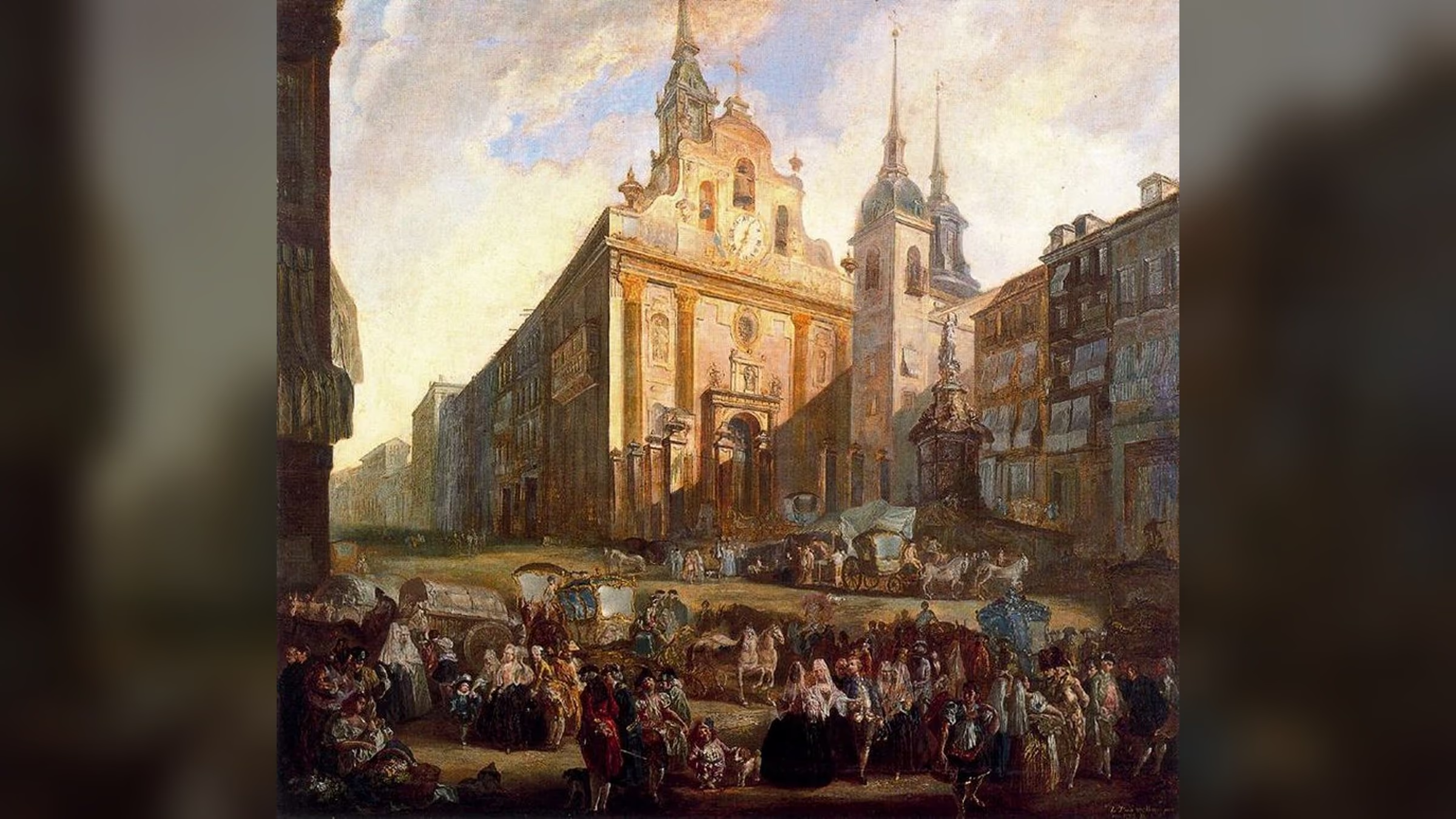
For nearly three centuries, a substantial part of the old Puerta del Sol was occupied by the convent of Nuestra Señora de la Victoria.
The complex stretched from the square toward today’s streets of la Victoria, la Cruz, Cádiz and Carretas. Its disappearance made it possible to open new streets, build shops and clear the ground that would later become part of the modern square.
Today no visible trace of the convent remains. Its name survives in Calle de la Victoria and in old depictions of Sol.
The Minims arrive in Madrid
The convent belonged to the Order of Minims of San Francisco de Paula. Fray Juan de Victoria petitioned Felipe II for permission to establish the community in Madrid, despite the opposition of the Augustinians of San Felipe el Real, whose convent stood very close by.
Construction was completed in 1561, and on August 1 of that year the first Mass was celebrated.
The building stood on the southeastern side of the old Puerta del Sol, in a space that is hard to recognize today because the street layout changed so profoundly.
The convent did not occupy only the facade visible from the square. Its quarters, courtyards and orchards extended deep into the block behind.
The Virgen de la Soledad
One of the church’s principal treasures was the image of Nuestra Señora de la Soledad, attributed to the sculptor Gaspar Becerra.
Devotion to the image grew immensely popular during the reigns of Felipe III and Felipe IV. It took part in the Holy Week processions and helped make the church one of the most frequented temples in the area.
The chronicles and literature of the period also mention a notably brief Mass, popularly known as the misa ligera, the “light Mass.” Its timing and brevity drew those who wished to fulfill their religious obligations quickly before continuing with their business in the city center.
The church appears in various literary works of the Spanish Golden Age, a sign of how familiar it was to Madrileños.
A great urban obstacle
The convent’s presence shaped the form of the square.
The old Puerta del Sol was narrow and lacked its present breadth. The Buen Suceso closed off the eastern end, San Felipe dominated the entrance to Mayor, and la Victoria occupied a considerable portion of the side nearest Carretas and the Carrera de San Jerónimo.
These religious buildings had been erected when Madrid was a city of a very different scale. As the population and the traffic grew, their walls and outbuildings came to be seen as obstacles to circulation and to the creation of new commercial space.
During the Peninsular War, the convent suffered damage and had to be restored. A few years later, the desamortización sealed its fate.
The demolition
The community was suppressed in 1836, and the building was eventually demolished.
Its disappearance freed up a large area right beside the Puerta del Sol. New streets, buildings and businesses appeared on the site. One of the best-known projects was the Pasaje Matheu, a shopping arcade inspired by Parisian models and inaugurated in 1847.
The convent vanished before the general renovation of Sol began in 1857. Its demolition, however, was one of the precedents that made the later transformation possible.
The square needed space, and that space was obtained largely through the disappearance of religious buildings.
The street that kept the name
Although no facade or visible remnant survives, Calle de la Victoria preserves the memory of the convent.
The name makes it possible to locate it roughly and to remember that beneath today’s blocks there once stood a great religious complex.
The story of la Victoria helps us understand that the Puerta del Sol was not created by an architectural project alone. First, convents, churches, houses and entire streets had to be swept away.
The great arc of buildings that seems to have defined the square forever was possible only because part of the earlier Madrid had disappeared.
Frequently asked questions
Where was the Convento de la Victoria?
When was the Convento de la Victoria built?
What happened to the Convento de la Victoria?
Does anything remain of the convent?
Sources
Keep exploring
History of the Puerta del Sol
From medieval gate to the symbolic centre of Madrid: the history of the Puerta del Sol, its great 19th-century renovation, the arrival of transport, its monuments and its role as a gathering place.
LeerThe great renovation that created the Puerta del Sol
The 1857-1862 renovation that created today's Puerta del Sol: the competing designs, the demolitions, Lucio del Valle's arc of buildings and the cost of the new square.
LeerKilometre Zero
The Kilometre Zero plaque, in front of the Real Casa de Correos in the Puerta del Sol, marks the historic origin of Spain's six radial highways. Its history since 1856 and today's compass rose.
LeerWhy It Is Called Puerta del Sol
Puerta del Sol was once a gateway into medieval Madrid, decorated with a sun. Discover how that vanished gate gave the square its name.
Leer