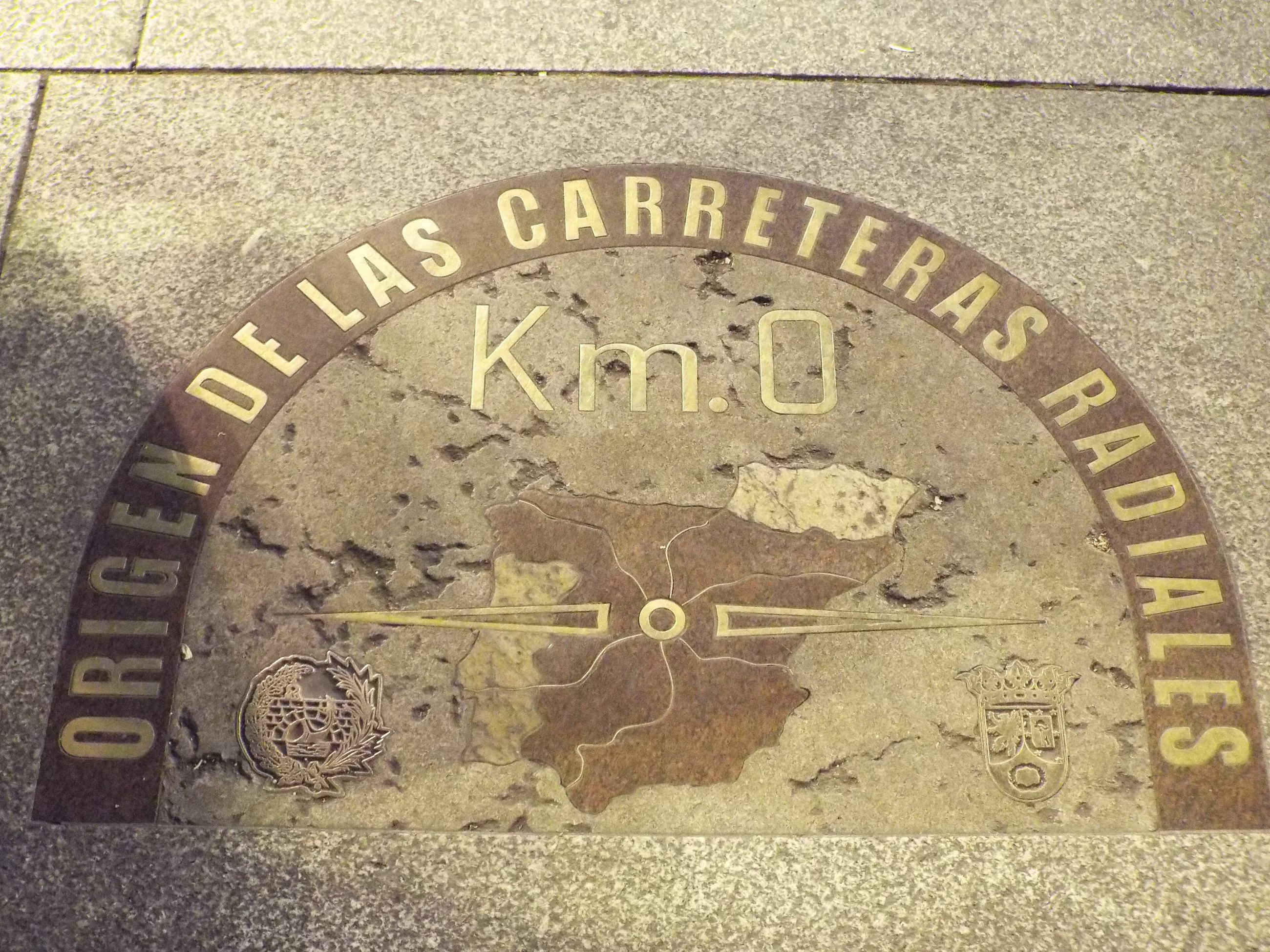
In front of the main entrance of the Real Casa de Correos lies a small granite-and-brass plaque. It marks Kilometre Zero, the point from which Spain’s main highways began to be measured.
It does not indicate the geographic centre of the country, nor does it mean that all of today’s highways physically begin there. It is a historic and administrative reference: the place Spain chose as the common origin for counting its distances.
A common starting point
For centuries, distances were expressed in leagues, miles or days of travel. Nor were they always measured from the same place. A road might begin at one of Madrid’s gates, an inn or an official building.
The adoption of the metric system in 1849 made it necessary to establish a common procedure. To state that a town lay one hundred kilometres from Madrid, someone had to decide from which precise point the counting began.
The Puerta del Sol met all the requirements. It was the capital’s main crossroads, it stood next to the Casa de Correos and it connected with the streets leading to the great national roads.
In December 1856, a first slab was laid in front of the building. A later instruction fixed its position on the extension of the central axis of the Ministry of the Interior building, ten meters from the facade.
Kilometre Zero therefore predates the great renovation of Sol. Construction of the modern square began just a few months later.
The radial highways
Spain’s great highways were organized on a radial model with Madrid at the centre. The N-I led toward Burgos and Irún; the N-II toward Zaragoza and Barcelona; the N-III toward Valencia; the N-IV toward Andalusia; the N-V toward Extremadura and Portugal; and the N-VI toward Galicia.
The number on a kilometre marker indicates the distance the highway has traveled from its origin, not the straight-line separation. Roads must adapt to mountains, rivers, towns and changes of route.
The A-1, A-2, A-3, A-4, A-5 and A-6 motorways inherited the logic and numbering of those highways, even though they no longer physically begin beside the plaque at Sol.
The 1950 plaque
The first slab served a technical purpose and lacked the recognizable look of today’s monument. In 1950, a decorative plaque was installed showing the map of Spain, the six highways and the inscription “Km. 0.”
The piece included the coat of arms of Madrid and the emblem of the civil engineers of roads, canals and ports. For decades it was set with an incorrect orientation: the arrows of the cardinal points did not match the square’s actual position. The error was corrected in the year 2000.
The passage of millions of pedestrians gradually wore down the surface. In 2009 it was replaced with a new granite-and-brass plaque, more durable but based on the same design.
The compass rose
During the remodeling that began in 2022, the plaque was temporarily removed. It returned in March 2023, surrounded by a large compass rose set into the pavement.
It bears the names of the provincial capitals and the two autonomous cities. The composition turns the small plaque into the centre of a symbolic map of Spain.
Many people photograph themselves with their feet beside the inscription. The gesture represents the start of a journey, even though digital maps and navigation systems can now calculate any route without using that point.
Kilometre Zero is no longer essential for driving across Spain. Its importance lies elsewhere: it recalls the moment when the country decided that all distances should begin to be counted from the same place.
Frequently asked questions
Where is Kilometre Zero?
What does Kilometre Zero mean?
Is Kilometre Zero the geographic centre of Spain?
When was Kilometre Zero placed?
Sources
Keep exploring
History of the Puerta del Sol
From medieval gate to the symbolic centre of Madrid: the history of the Puerta del Sol, its great 19th-century renovation, the arrival of transport, its monuments and its role as a gathering place.
LeerThe great renovation that created the Puerta del Sol
The 1857-1862 renovation that created today's Puerta del Sol: the competing designs, the demolitions, Lucio del Valle's arc of buildings and the cost of the new square.
LeerWhy It Is Called Puerta del Sol
Puerta del Sol was once a gateway into medieval Madrid, decorated with a sun. Discover how that vanished gate gave the square its name.
LeerWhat to See in the Puerta del Sol
A walk through the nine essential sights of the Puerta del Sol: Kilometre Zero, the Casa de Correos, the clock, Charles III, the Mariblanca, the Bear and the Strawberry Tree, the Hotel de París, Tío Pepe and La Fonda.
Leer