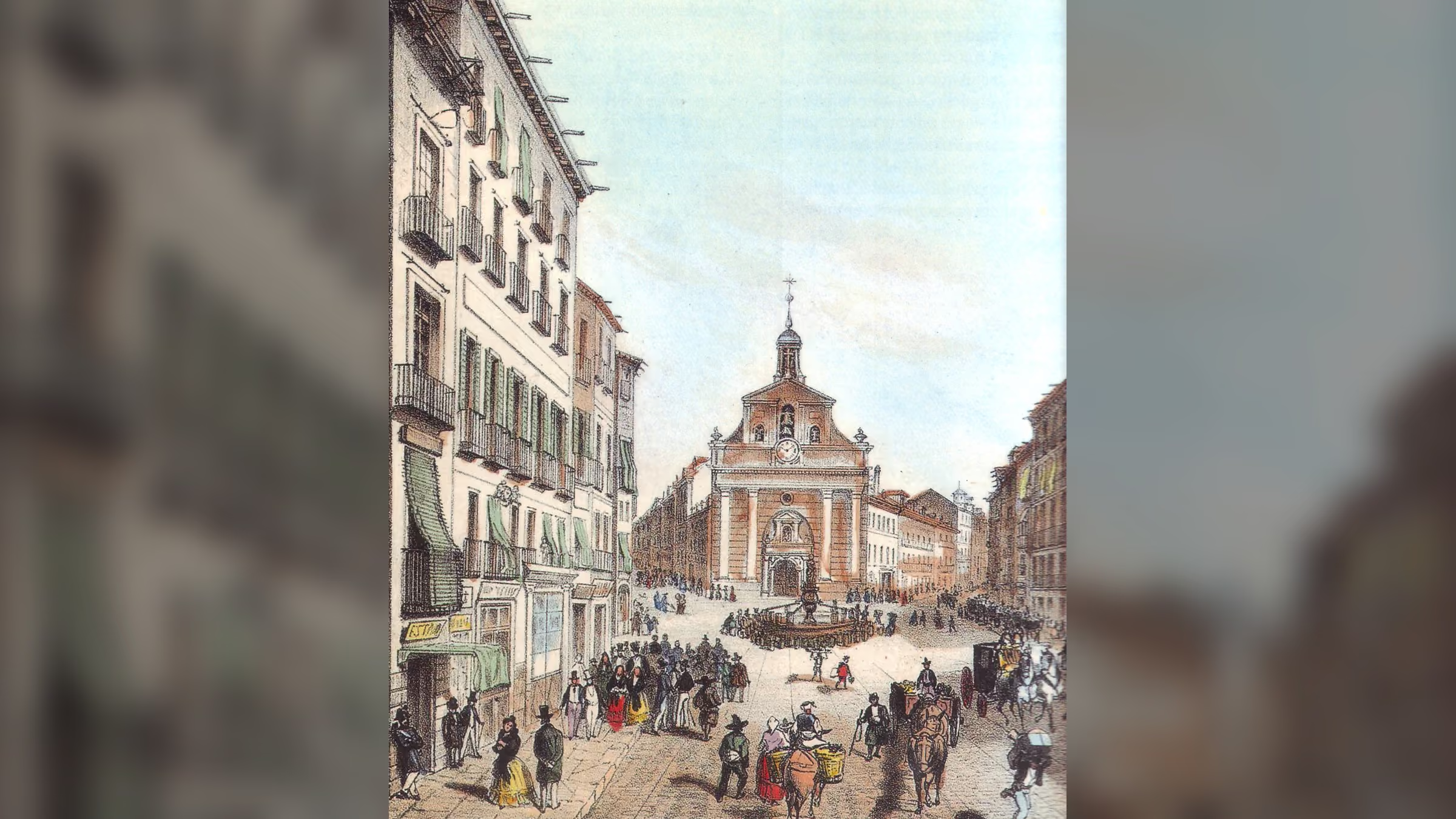
Puerta del Sol has no gate. Nor is there any wall, tower or arch that reveals the origin of its name. And yet, before becoming a square, it really was one of the entrances to Madrid.
The gate stood on the eastern boundary of the medieval city and connected it with the roads leading to Alcalá de Henares and Guadalajara. It was decorated with a sun, probably related to its eastward orientation, the direction of the sunrise. The structure disappeared more than four centuries ago, but the space that had formed around it kept its name.
A Gate on the Edge of Madrid
Medieval Madrid was far smaller than the city of today. Its earliest walled enclosures surrounded the core clustered around the Alcázar, the area of the present Royal Palace and its neighboring streets.
When the population began to grow beyond the walls, new districts, or arrabales, appeared. Houses spread out along the roads, markets and churches, especially to the north and east.
To protect and control these new neighborhoods, an outer wall was built with several entrances. It was not a grand monumental fortification, but a simpler structure that made it possible to close off passage and monitor the entry of people, animals and goods.
One of those entrances was the Puerta del Sol. It was probably a modest postern gate, nothing like the grand Puerta de Alcalá built centuries later. Its importance came not from its architecture, but from its position on one of the principal roads into Madrid.
The Sun That Gave It Its Name
City gates could take their names from the road they led to, from a nearby building, from a religious image or from some element mounted above them.
In this case, the name came from the sun that decorated the entrance. The original piece has not survived, and we cannot say for certain whether it was painted, carved or mounted on the gate as a freestanding emblem.
The traditional explanation links its presence to the gate’s eastward orientation. Those leaving Madrid at that point traveled toward Alcalá and Guadalajara, in the direction of the sunrise.
There is also a legend connecting the gate to the Revolt of the Comuneros. According to this version, Madrileños supposedly built or reinforced a defensive work in 1520 and placed a sun upon it.
It is possible that the gate was repaired or strengthened during those conflicts, but the name appears earlier. The connection with the Comuneros is part of Sol’s lore, though it cannot be considered the most reliable explanation of the name’s origin.
The City Grows Around the Gate
When it was built, the Puerta del Sol separated the city from the roads beyond. Inside lay the streets and houses of Madrid; outside began still sparsely developed land, orchards and routes to other towns.
But Madrid kept growing eastward. Houses rose on both sides of the wall, and the old outlying districts were absorbed into the city. Near the gate appeared the hospital that would later be known as the Buen Suceso, along with fountains, stalls, lodgings and shops serving travelers.
The entrance no longer clearly divided inside from outside. It had been engulfed by the city itself and had become an obstacle to movement through an increasingly busy area.
The gate and the wall were demolished in the 17th century. The structure vanished, but Madrileños kept using its name to refer to the place.
From Gate to Square
After the demolition, Sol did not immediately become a square like the one we know today. Throughout the 17th and 18th centuries it was an elongated, narrow, irregular space formed by the crossing of Mayor, Arenal, Alcalá, Carretas and the Carrera de San Jerónimo.
At one end stood the church of the Buen Suceso and, in front of it, the fountain of the Mariblanca. On the western side rose the convent of San Felipe el Real, whose steps were known as the Mentidero de la Villa because news and rumours were traded there.
The old gate no longer existed, but the place retained the function that had grown up around it. It remained a crossing point for travelers, carriages, goods and information.
The Real Casa de Correos was completed in 1768 and, between 1857 and 1862, a great renovation created the modern square. Buildings and entire blocks were demolished, and the great arc of façades facing the Casa de Correos was built.
The transformation could have been the occasion for a new name. It was not. The new square kept the name of a small medieval postern gate that had been gone for more than two centuries.
A Gate That Ended Up at the Centre
The Puerta del Sol was born on Madrid’s eastern boundary. Today it lies at the center of a city that stretches for kilometers in every direction.
It was not the gate that moved to the center. It was Madrid that grew around it. The roads became streets, the land beyond was filled with new neighborhoods, and the old entrance ended up lending its name to a square, a Metro station and a Cercanías commuter rail station.
The official name remains Puerta del Sol, though in everyday speech Madrileños usually just say Sol.
The structure disappeared more than four hundred years ago, but by then its name no longer belonged only to a gate.
It belonged to the place.
Frequently asked questions
Why is it called Puerta del Sol if there is no gate?
Where exactly was the gate?
Why a sun?
Why isn't it called Plaza del Sol?
Sources
Keep exploring
History of the Puerta del Sol
From medieval gate to the symbolic centre of Madrid: the history of the Puerta del Sol, its great 19th-century renovation, the arrival of transport, its monuments and its role as a gathering place.
LeerThe great renovation that created the Puerta del Sol
The 1857-1862 renovation that created today's Puerta del Sol: the competing designs, the demolitions, Lucio del Valle's arc of buildings and the cost of the new square.
LeerKilometre Zero
The Kilometre Zero plaque, in front of the Real Casa de Correos in the Puerta del Sol, marks the historic origin of Spain's six radial highways. Its history since 1856 and today's compass rose.
LeerWhat to See in the Puerta del Sol
A walk through the nine essential sights of the Puerta del Sol: Kilometre Zero, the Casa de Correos, the clock, Charles III, the Mariblanca, the Bear and the Strawberry Tree, the Hotel de París, Tío Pepe and La Fonda.
Leer