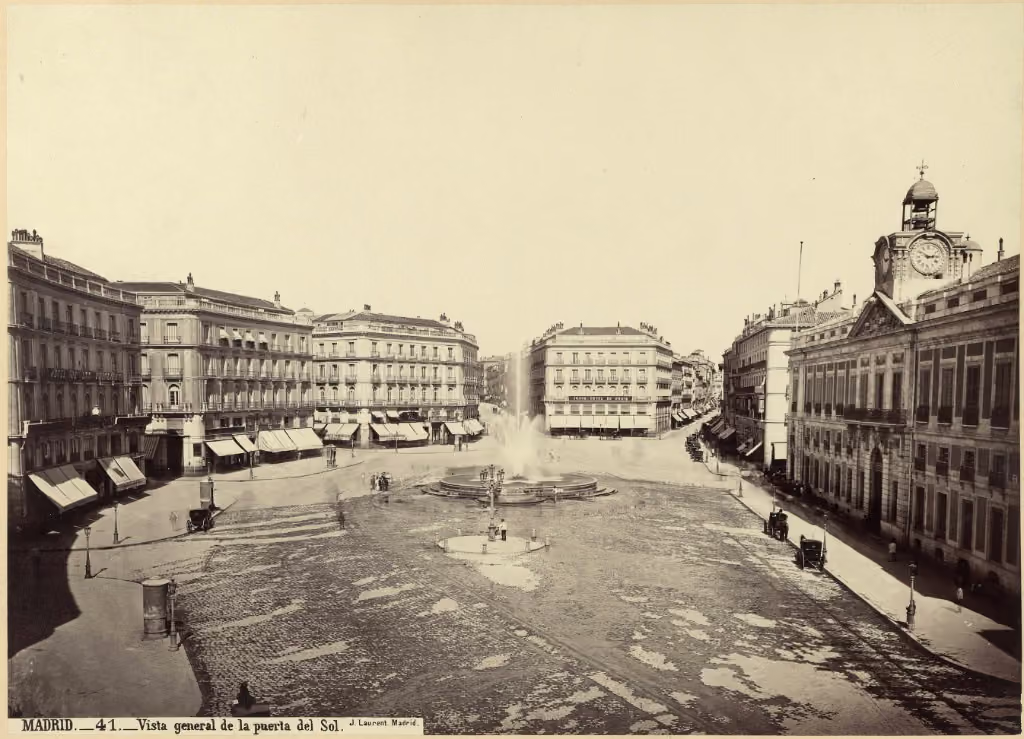
The Puerta del Sol was not born as a square. During the Middle Ages it was one of Madrid’s eastern entrances, opened in an enclosure that protected the outskirts that had grown beyond the old walls. From there, the roads set out toward Alcalá de Henares and Guadalajara. The gate disappeared more than four centuries ago, but the space that formed around it kept its name.
For a long time, Sol was little more than an irregular crossroads. Houses jutted forward and fell back without following any common alignment, and the streets converged at different angles. At one end stood the church and hospital of Buen Suceso; at the other, the convent of San Felipe el Real. Between the two gathered vendors, carriages, water carriers, travelers and people who came to hear the news.
The square we see today was created during the 19th century, but its importance as the centre of Madrid began much earlier.
The place for news
The steps of San Felipe el Real were known as the Mentidero de la Villa — the town’s gossip mill. Soldiers, merchants, servants, officials and travelers gathered there to trade news and rumors. What happened at court could be known in that spot before it appeared in any official document.
In 1630, a large fountain crowned by the figure Madrilenians called the Mariblanca was installed in front of the Buen Suceso. For more than two centuries it was the most recognizable image of Sol. The fountain supplied water to the neighbors and drew water carriers, animals and vendors every day.
In 1768, the Real Casa de Correos was completed. Its straight, regular facade contrasted with the jumble of houses around it. From there, the correspondence entering and leaving Madrid was organized, reinforcing Sol’s role as the centre of communications.
The Casa de Correos would eventually become the Ministry of the Interior and, later, the seat of the Presidency of the Community of Madrid. Its presence explains why a good part of the political events of the last two centuries have ended up unfolding in front of its balconies.
The old square disappears
By the mid-19th century, Sol had become one of the most congested places in Madrid. The buildings left little room for carriages and pedestrians to pass, while the new railway stations swelled the flow of arriving travelers.
In 1854, the church of the Buen Suceso was demolished. Shortly afterwards, preparations began for a far more ambitious renovation. After years of proposals and debate, works directed by Lucio del Valle, Juan Rivera and José Morer got underway in 1857.
Around thirty buildings were demolished and several city blocks disappeared. The surface area of the square more than doubled. The Casa de Correos was preserved and, facing it, the great arc of facades that still defines the image of Sol was built.
The works officially ended in 1862 and cost 33,602,250 reales. The new square offered uniform architecture, wider streets and buildings ready to house hotels, cafés, shops and homes.
The Fonda de los Príncipes opened on October 1, 1861, while the renovation was still underway. The Hotel de París followed in 1864, and the Losada clock arrived at the Casa de Correos in 1866. Within a few years, many of the elements that turned Sol into the centre of Madrid life had appeared.
The hub of transport
The renovation improved circulation, but the new square quickly filled up again. In 1871, Madrid’s first tram passed through Sol, still drawn by animals. At the end of the century came the electric trams, and the square was blanketed with tracks and cables.
In 1919, the first Metro line was inaugurated between Sol and Cuatro Caminos. The station turned the old crossroads into the starting point of a new underground network. New lines followed and, in 2009, the Cercanías commuter rail station.
For much of the 20th century, Sol was crossed by trams, buses, taxis and cars. Successive renovations tried to organize the traffic without ever preventing the square from becoming saturated again. In 2020 it was finally closed to vehicles, and the remodeling completed in 2023 consolidated its pedestrian character.
Transport did not disappear. It moved beneath the pavement.
Monuments that came later
Many of the elements that now seem inseparable from Sol are relatively recent. The visible plaque of Kilometre Zero was installed in 1950, though the highways had been measured from there since 1856. The Bear and the Strawberry Tree arrived in 1967. The statue of Charles III was placed in 1994 and moved to the centre of the current fountain in 2023.
The Mariblanca returned to the square as a replica in 1986. The Tío Pepe sign sat for decades atop the old Hotel de París and, since 2014, has crowned the building of La Fonda de los Príncipes.
Sol has never kept a fixed image. Each generation has added, removed or relocated elements according to its own idea of the square.
The place where Madrid gathers
The Puerta del Sol has been the scene of the uprising of May 2, 1808, of 19th-century revolutions, of the proclamation of the Second Republic, of demonstrations, sporting celebrations and citizen rallies. In 2011, the 15-M encampment once again made it the centre of Spanish political debate.
It is also the place of the New Year’s Eve chimes. The custom of coming to Sol to eat the twelve grapes began at the end of the 19th century and spread to the rest of Spain thanks to radio and television. Every December 31, the Losada clock once again places the square at the centre of the country.
Sol has changed because it has always had to serve too many purposes. It is a station, a commercial space, a thoroughfare, a political stage and one of Madrid’s main meeting points.
The old gate disappeared centuries ago. The crossroads that grew up around it ended up becoming the place from which the city measures itself, communicates and contemplates its own reflection.
Frequently asked questions
What century does the Puerta del Sol date from?
Why is it called Puerta del Sol?
What historic events took place in the Puerta del Sol?
When was the current square built?
Sources
Keep exploring
The great renovation that created the Puerta del Sol
The 1857-1862 renovation that created today's Puerta del Sol: the competing designs, the demolitions, Lucio del Valle's arc of buildings and the cost of the new square.
LeerKilometre Zero
The Kilometre Zero plaque, in front of the Real Casa de Correos in the Puerta del Sol, marks the historic origin of Spain's six radial highways. Its history since 1856 and today's compass rose.
LeerWhy It Is Called Puerta del Sol
Puerta del Sol was once a gateway into medieval Madrid, decorated with a sun. Discover how that vanished gate gave the square its name.
LeerWhat to See in the Puerta del Sol
A walk through the nine essential sights of the Puerta del Sol: Kilometre Zero, the Casa de Correos, the clock, Charles III, the Mariblanca, the Bear and the Strawberry Tree, the Hotel de París, Tío Pepe and La Fonda.
Leer