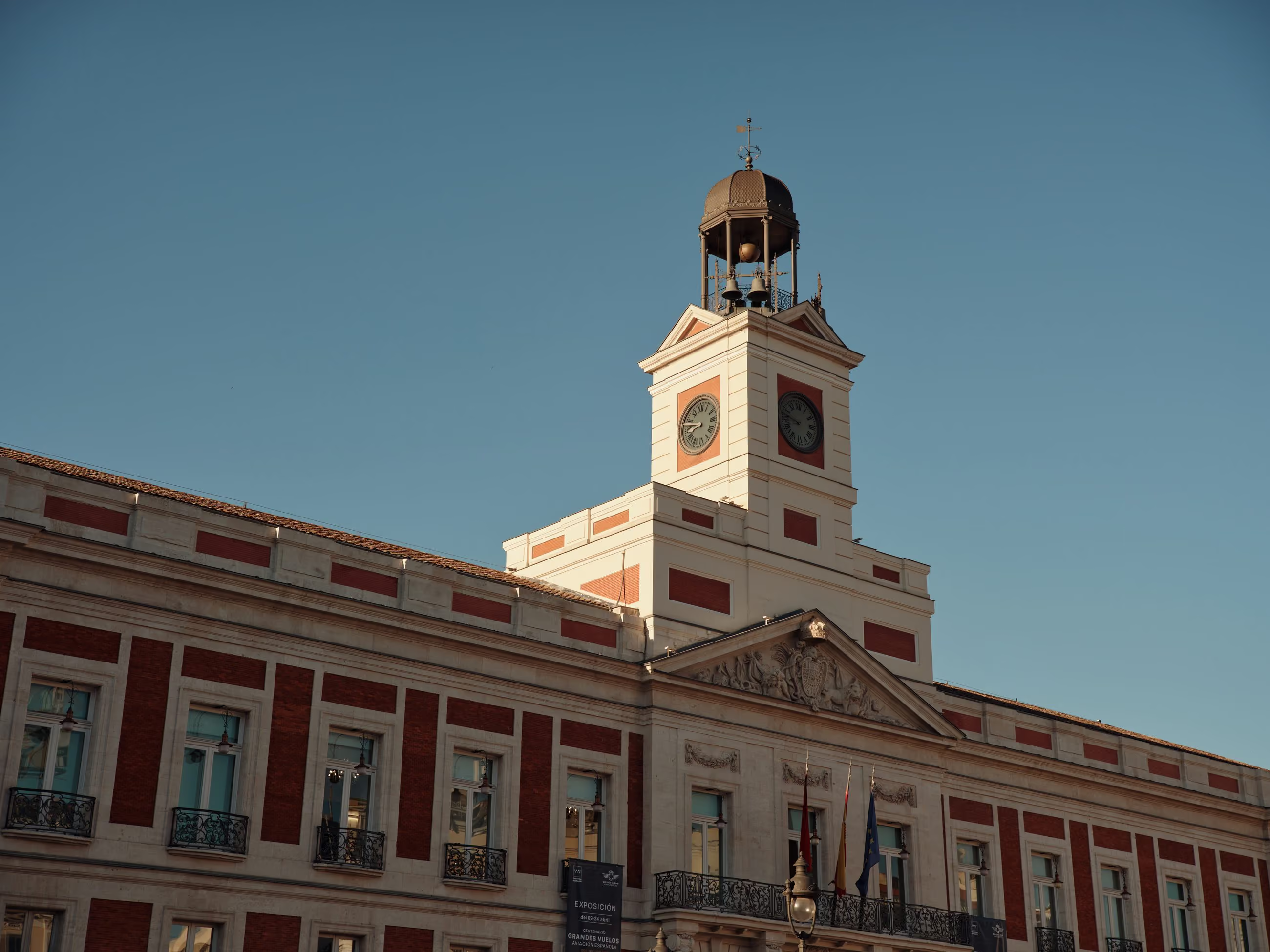
The Puerta del Sol can be crossed in a few minutes, yet almost every one of its elements has a story of its own. Here you will find the origin of Spain’s highways, the New Year’s Eve clock, the symbol of Madrid, an old post office, a 19th-century hotel turned shop and one of the most recognizable illuminated advertisements in the country.
Today’s square is fully pedestrianized and lets you take in all of these sights without ever leaving it. The latest remodeling reorganized its monuments, relocated the statues and reclaimed a large open central space in front of the Real Casa de Correos.
The Puerta del Sol in 15 minutes
The full route covers barely a few hundred meters. It can start at Kilometre Zero, continue past the Casa de Correos and the clock, circle the Charles III fountain and then follow the two ends of the northern arc, where the Mariblanca and the Bear and the Strawberry Tree stand.
From any point in the square you can also see the former Hotel de París, the Tío Pepe sign and the building of La Fonda de los Príncipes.
Recommended route:
Kilometre Zero → Casa de Correos → Losada clock → Charles III → Mariblanca → former Hotel de París → Bear and Strawberry Tree → Tío Pepe and La Fonda de los Príncipes
1. Kilometre Zero
The visit can begin in front of the main entrance of the Real Casa de Correos. Set into the pavement is the Kilometre Zero plaque, the point from which Spain’s six great radial highways began to be measured.
The reference point was established in 1856, though the best-known plaque appeared in 1950. The current piece, made of granite and brass, was surrounded in 2023 by a large compass rose bearing the names of the provincial capitals and the autonomous cities.
It is small and easy to miss when the square is crowded. Look for it directly in front of the building’s central door.
Read the history of Kilometre Zero →
2. The Real Casa de Correos
Facing the great arc of buildings stands the Real Casa de Correos, built between 1766 and 1768 during the reign of Charles III. It is the oldest surviving building on the square and the one that ended up determining its orientation and shape.
It was born to organize the correspondence entering and leaving Madrid. It later became the Ministry of the Interior, headquarters of the Directorate-General of Security and, since 1985, the seat of the Presidency of the Community of Madrid.
On its facade you will find the main balcony, several commemorative plaques and the clock tower.
Discover the Real Casa de Correos →
3. The Losada clock
Atop the Casa de Correos sits the most famous clock in Spain. It was built by José Rodríguez Losada, a clockmaker from León who had settled in London, and was inaugurated on November 19, 1866.
Every December 31 it sets the rhythm of the twelve grapes. The sequence begins with the descent of the ball above the tower, continues with the four quarter chimes and ends with the twelve strokes of midnight.
The clock can be viewed head-on from the centre of the square and from the balconies of number 11, used for decades by television networks to broadcast New Year’s Eve.
Learn the history of the clock and the chimes →
4. The statue of Charles III
At the centre of the square, inside an oval fountain, stands the equestrian statue of Charles III. Although it looks old, the monument arrived at Sol in 1994.
The king was chosen to preside over the square because of his role in the modernization of Madrid and his connection to the Casa de Correos, built during his reign. The figure was made by Eduardo Zancada and Miguel Ángel Rodríguez from an 18th-century model.
In 2023, the statue and its pedestal were moved to the centre of the new fountain. The operation was especially complex due to the weight of the ensemble and the Metro and Cercanías lines and utilities that run beneath the pavement.
Read the story of Charles III and his statue →
5. The Mariblanca
The Mariblanca stands at the western end of the line of benches along the northern arc, near the entrance to Calle del Arenal and opposite number 10.
The figure probably represents Venus and is a replica of the statue that crowned one of Sol’s old fountains from 1630 onward. Madrilenians began calling her Mariblanca because of the color of her marble.
The original statue, acquired in Florence in 1625, is kept safe in the Casa de la Villa. The replica returned to Sol in 1986 and was moved to its current position in August 2023.
Discover the travels of the Mariblanca →
6. The former Hotel de París
At the corner between Calle de Alcalá and the Carrera de San Jerónimo stands the present-day Apple Store. For 142 years, the building was the Hotel de París.
It opened in 1864 on the site once occupied by the church and hospital of the Buen Suceso. It was one of the grand hotels of the new Puerta del Sol and hosted, among other travelers, the French painter Édouard Manet.
Its ground floor housed the Café de la Montaña, where an argument in 1899 caused the injury that ultimately cost Ramón María del Valle-Inclán his left arm.
The hotel closed in 2006 and Apple opened in 2014. For decades, the Tío Pepe sign stood on its rooftop.
Step into the history of the Hotel de París →
7. The Bear and the Strawberry Tree
El Oso y el Madroño — the Bear and the Strawberry Tree — currently stands at the eastern end of the line of benches along the northern arc, near Calle de Alcalá.
The sculpture was created by Antonio Navarro Santafé and inaugurated in January 1967. It represents the coat of arms of Madrid: a bear rearing up before a strawberry tree, accompanied by seven stars.
The statue has changed position several times. In 1986 it was moved to the beginning of Calle del Carmen; in 2009 it returned near its original location and, in March 2023, it moved to the spot it occupies today. The work stands about four meters tall and weighs around twenty tonnes.
Learn the origin of the Bear and the Strawberry Tree →
8. The Tío Pepe sign
Look up toward the northern arc and the great Tío Pepe sign appears. Since 2014 it has stood above number 11, on the rooftop of the building of La Fonda de los Príncipes.
The character of the bottle with its short jacket, hat and guitar was created in 1935 by the advertising man Luis Pérez Solero. The great illuminated sign was originally installed atop the Hotel de París and remained there for more than half a century.
It was removed in 2011 during the building’s renovation and lit up again on May 8, 2014 from its new location. It is one of the few great historic advertisements to survive on the square.
Read the history of the Tío Pepe sign →
9. La Fonda de los Príncipes
Beneath the sign stands La Fonda de los Príncipes, at number 11 on the Puerta del Sol itself. It is not next to the square: it is part of it.
The establishment opened on October 1, 1861, while the great renovation of Sol was still unfinished. Over its history it was the Hotel de los Príncipes, the Gran Hotel de la Paix, the Hotel Americano, the Pensión Americana and the Hostal Americano.
After closing in March 2020, it recovered its original name and reopened in January 2026. Its balconies look directly onto the Casa de Correos, and some have been used for decades to broadcast the New Year’s Eve chimes.
Learn the history of La Fonda de los Príncipes →
One last detail beneath the square
The visit can be extended by entering the Sol station. One of its concourses preserves remains of the old church and hospital of the Buen Suceso, demolished in 1854 and rediscovered during the Cercanías works.
The square therefore has two levels. Above the pavement stand its monuments and buildings; below it run the Metro lines, the Cercanías station and fragments of the Madrid that disappeared.
Discover the church and hospital of the Buen Suceso →
Before leaving Sol
From the centre of the square it is worth pausing to take in the whole ensemble. The Casa de Correos occupies the south side; facing it, the great arc of facades built during the 19th-century renovation gathers hotels, homes and shops that seem to form a single building.
The Puerta del Sol is not a closed museum. All of its elements remain part of a square filled with travelers, residents, workers and people crossing the centre of Madrid.
Walking it takes fifteen minutes.
Understanding it can take several centuries.
Frequently asked questions
What is there to see in the Puerta del Sol?
How much time do you need to see the Puerta del Sol?
Where is the Bear and the Strawberry Tree now?
Where is Kilometre Zero?
Can you visit the Casa de Correos?
Is La Fonda de los Príncipes in the Puerta del Sol?
Keep exploring
History of the Puerta del Sol
From medieval gate to the symbolic centre of Madrid: the history of the Puerta del Sol, its great 19th-century renovation, the arrival of transport, its monuments and its role as a gathering place.
LeerThe great renovation that created the Puerta del Sol
The 1857-1862 renovation that created today's Puerta del Sol: the competing designs, the demolitions, Lucio del Valle's arc of buildings and the cost of the new square.
LeerKilometre Zero
The Kilometre Zero plaque, in front of the Real Casa de Correos in the Puerta del Sol, marks the historic origin of Spain's six radial highways. Its history since 1856 and today's compass rose.
LeerWhy It Is Called Puerta del Sol
Puerta del Sol was once a gateway into medieval Madrid, decorated with a sun. Discover how that vanished gate gave the square its name.
Leer