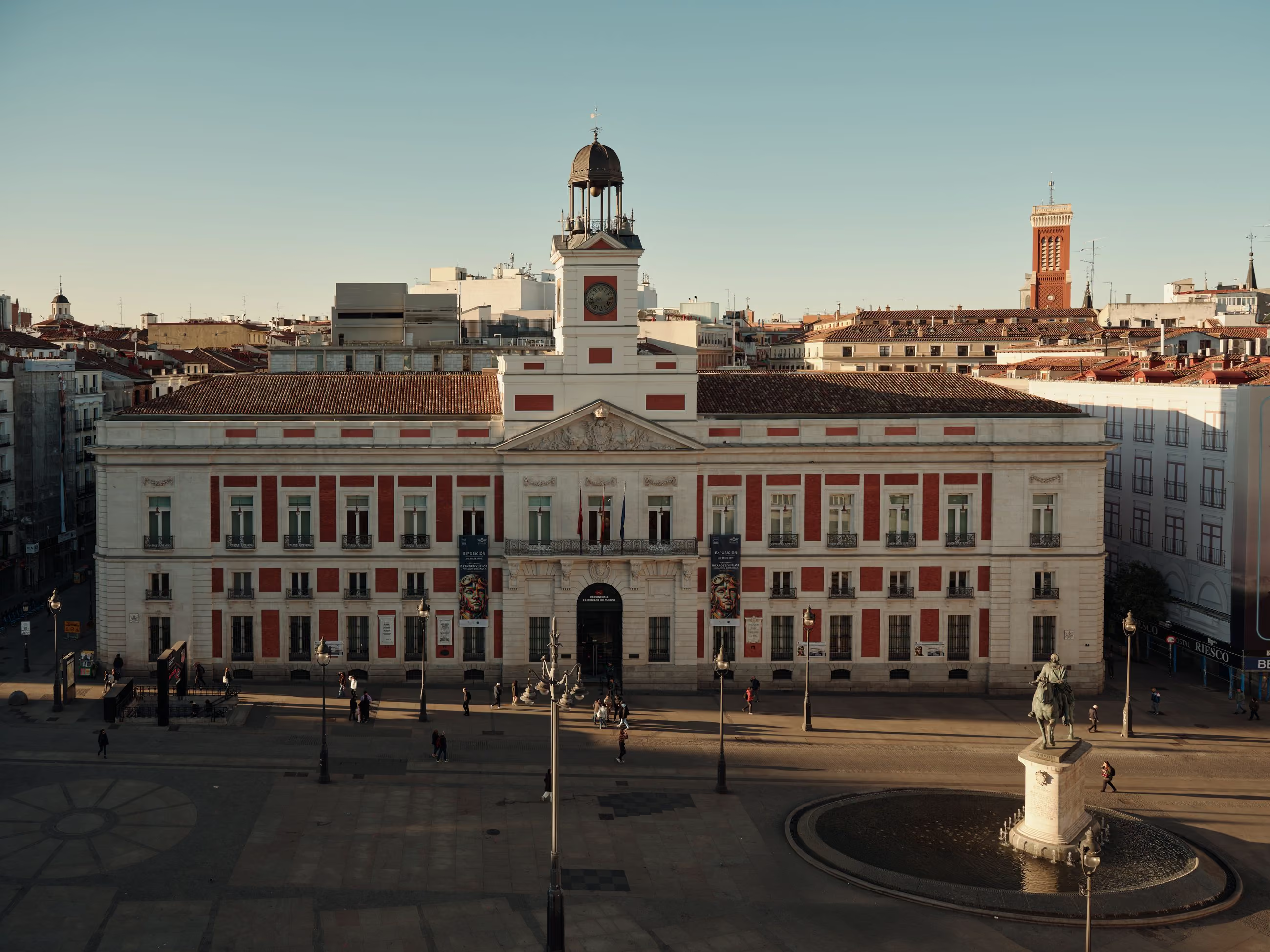
The Real Casa de Correos is the oldest surviving building in the Puerta del Sol. It was built between 1766 and 1768 and has served very different purposes: post office, Ministry of the Interior, headquarters of the Directorate-General of Security and, since 1985, seat of the Presidency of the Community of Madrid.
On its facade sits the Losada clock, and in front of it lie Kilometre Zero and the statue of Charles III. Its balcony has been used to announce political change, address crowds and welcome the New Year’s Eve chimes each year.
The first great building of Sol
Ferdinand VI initially commissioned the project from Ventura Rodríguez, but his design was never executed. After Charles III came to the throne, construction was entrusted to the French architect Jaime Marquet.
The building was arranged around two courtyards and given a facade of red brick and white stone. Its composition was simple and regular, with a central body set off by the main balcony and the coat of arms of Charles III.
When it opened in 1768, the rest of Sol was still a jumble of irregular constructions. The Casa de Correos introduced an entirely new scale and ended up shaping the renovation of the whole square. Nearly a century later, it was the only major building preserved when the north side was demolished to build the current arc.
From post office to Ministry of the Interior
The Casa de Correos organized the correspondence arriving in and leaving Madrid. Its courtyards allowed carriages to enter, and its offices housed the employees charged with sorting and distributing the letters.
The building also housed services related to security and administration. In 1847 it was remodeled to install the Ministry of the Interior, responsible for much of the state’s domestic policy. For some time, the postal service continued to occupy part of the ground floor.
This new role turned the building into one of Madrid’s main centres of power. Decisions taken inside could spark rallies, protests or celebrations in the square.
In 1854, the clock from the church of the Buen Suceso was placed in its tower. It kept poor time and became the butt of jokes until it was replaced by José Rodríguez Losada’s mechanism in 1866.
The building of great events
The Casa de Correos has witnessed some of the key episodes in Madrid’s history. On May 2, 1808, the fighting against the French troops spread through its surroundings. During the revolutions of the 19th century, the balcony and facade were used to hang flags and announce political decisions.
On November 12, 1912, Prime Minister José Canalejas was assassinated beside the San Martín bookshop, a few meters from the building. His body was carried inside and laid on a table that is still preserved.
On April 14, 1931, the members of the provisional Government of the Second Republic took over the Ministry of the Interior. From there, Niceto Alcalá-Zamora addressed the crowd gathered in Sol and used the radio to announce the formation of the new regime.
During the Civil War, the square suffered bombing and artillery fire. Some of the impacts can still be made out on elements of the facade.
The Directorate-General of Security
After the Civil War, the building became the headquarters of the Directorate-General of Security. Its premises were used to detain, interrogate and torture opponents during the dictatorship.
That chapter is an inseparable part of its history. While Sol remained a place of passage, commerce and celebration, inside the building operated the services in charge of political repression.
In October 2025, the former Directorate-General of Security housed in the Casa de Correos was declared a Site of Democratic Memory. The decision opened an institutional dispute over how to remember that era, but it officially recognized the building’s connection to Francoist repression.
Seat of the Community of Madrid
In 1985 it was agreed to make the Casa de Correos the seat of the Presidency of the Community of Madrid. During the 1990s, a comprehensive restoration recovered courtyards, interior spaces and historic features. The works were completed in 1998.
Today it remains the main seat of the regional government. The building retains its political role, and the square continues to be used for protests and celebrations linked to the decisions made inside.
Several commemorative plaques adorn the facade. Some recall the uprising of May 2, the attacks of March 11, 2004, and the people who died during the pandemic.
The Casa de Correos has changed its purpose, but it has never ceased to occupy the centre of public life in Sol. The mail, the security services, the government and the New Year’s Eve chimes have all passed through a building that has been looking out over the same square for more than two centuries.
Frequently asked questions
What is the Real Casa de Correos?
When does the Casa de Correos clock date from?
Why is Kilometre Zero in front of the Casa de Correos?
Sources
Keep exploring
History of the Puerta del Sol
From medieval gate to the symbolic centre of Madrid: the history of the Puerta del Sol, its great 19th-century renovation, the arrival of transport, its monuments and its role as a gathering place.
LeerThe great renovation that created the Puerta del Sol
The 1857-1862 renovation that created today's Puerta del Sol: the competing designs, the demolitions, Lucio del Valle's arc of buildings and the cost of the new square.
LeerKilometre Zero
The Kilometre Zero plaque, in front of the Real Casa de Correos in the Puerta del Sol, marks the historic origin of Spain's six radial highways. Its history since 1856 and today's compass rose.
LeerWhy It Is Called Puerta del Sol
Puerta del Sol was once a gateway into medieval Madrid, decorated with a sun. Discover how that vanished gate gave the square its name.
Leer