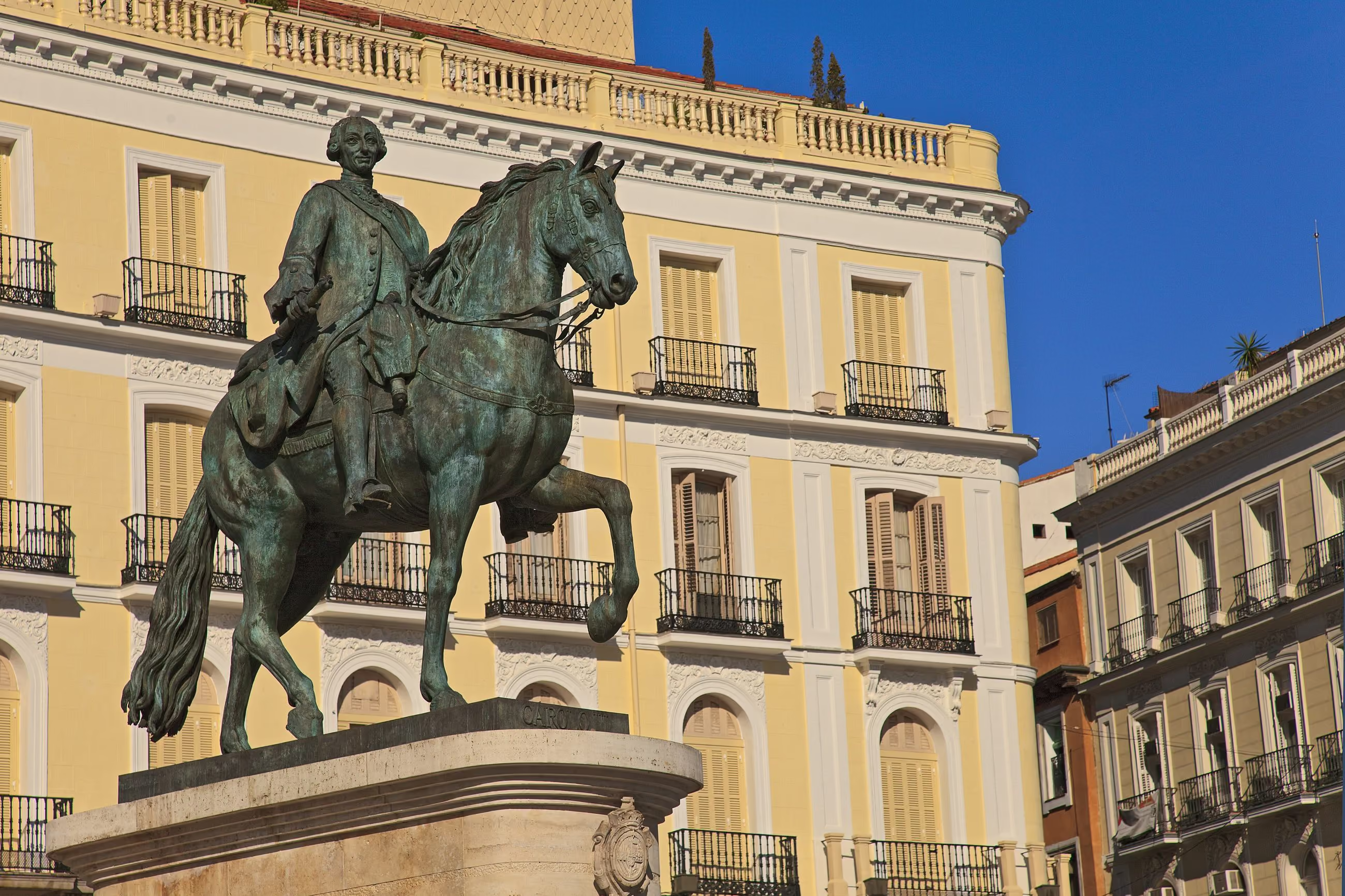
At the center of Puerta del Sol stands the equestrian statue of Charles III. The king appears in full ceremonial dress, mounted on a horse advancing at a slow walk, gazing toward the Real Casa de Correos, the building erected during his reign.
Although it looks like an old monument, the statue arrived in the square in 1994. It is more recent than the Bear and the Strawberry Tree, the Tío Pepe sign and the first television broadcasts of the New Year’s Eve chimes.
Charles III never knew Puerta del Sol in its current form. The square’s great renovation began almost seventy years after his death. And yet few figures are so closely tied to the modernization of Madrid and to the landmarks we identify with Sol today.
The King Who Set Out to Modernize Madrid
Charles III was born in Madrid in 1716. Before becoming King of Spain he had ruled Naples and Sicily for more than twenty years. He returned to Spain in 1759, after his brother Ferdinand VI died without an heir.
When he came to the throne, he found a capital that had grown up around the court but still suffered serious problems with paving, cleaning, lighting and sanitation. Many streets were dark, thick with mud, and lacked adequate systems for draining water and waste.
During his reign, public lighting and street-cleaning services were expanded, streets and drains were improved, and regulations were passed to bring order to façades and the use of urban space. Hospitals, gardens, scientific institutions, promenades and major public works were also championed.
These reforms were not always well received. A remark is attributed to the king to the effect that Madrileños were like children, who cried when they were washed. Whether or not it is entirely literal, it captures the image Charles III left behind: a ruler determined to transform Madrid, even when the city resisted.
That is why he came to be known as the best mayor of Madrid, even though he never actually held the office.
The Casa de Correos
The most direct link between Charles III and Puerta del Sol is the Real Casa de Correos.
The project had been commissioned during the reign of Ferdinand VI, but Charles III ultimately entrusted the work to the French architect Jaime Marquet. The building was constructed between 1766 and 1768 to organize the mail arriving in and departing from the capital.
Its great straight façade stood out among the irregular houses of the old Puerta del Sol. When the square was completely remodeled between 1857 and 1862, the Casa de Correos was preserved and became the principal reference point of the new space.
Charles III never saw the great arc of buildings, the Losada clock or Kilometre Zero. But the building raised during his reign ended up shaping the modern square.
His government also promoted the construction of the great highways radiating out from Madrid toward the different regions of Spain. That radial system was the forerunner of the national roads that, many years later, would begin to be measured from the Kilometre Zero marker in front of the Casa de Correos.
A King Without a Statue
Charles III died in 1788. Despite the mark he had left on Madrid, the city did not raise a great statue in his memory at the time.
Philip III had his monument in the Plaza Mayor, and Philip IV presided over the Plaza de Oriente. Charles III, by contrast, went two centuries without an equestrian statue in the heart of the capital.
At the end of the 20th century, the City Council decided to correct that absence. The monument’s design took as its reference a small 18th-century figure kept at the Real Academia de Bellas Artes de San Fernando and traditionally attributed to the sculptor Juan Pascual de Mena.
Sculptors Eduardo Zancada and Miguel Ángel Rodríguez used that model as their starting point. They also studied the portraits of Charles III painted by Goya and Anton Raphael Mengs in order to reproduce his face with greater precision.
The king appears in a dress coat, waistcoat, breeches, wig and various decorations. On his chest he wears the Golden Fleece and the cross of the Order of Charles III. With one hand he holds the reins; with the other, a commander’s baton.
He is not portrayed as a warrior king. The horse advances at a walk, and the figure conveys serenity rather than force. It is an image of Charles III as governor and reformer.
Madrileños Choose Sol
Before deciding where to install the statue, the City Council organized a public consultation.
In December 1993, the figure was displayed provisionally in Puerta del Sol and several possible locations were presented. Among them were the square itself and the Puerta de Alcalá, one of the most important monuments built during Charles III’s reign.
Puerta del Sol received the most votes.
The choice linked the king to the Casa de Correos and to the origin point of Spain’s radial highways. It also placed him at the symbolic center of Madrid, in a square crossed daily by thousands of people.
The statue was permanently installed in December 1994.
The pedestal bears the king’s name and the phrase with which Madrid continues to remember him:
Charles III, King of Spain, the best mayor of Madrid.
Around the base runs a long inscription summarizing the principal events and reforms of his reign.
The New Location
The renovation of Puerta del Sol carried out between 2022 and 2023 changed the monument’s position once again.
The statue was moved to the center of the new oval fountain. The operation proved especially complex because the ensemble weighs dozens of tons and the square sits above Metro lines, Cercanías tunnels, utility conduits and technical spaces.
The pedestal was moved first, followed by the bronze figure. A structure had to be built capable of distributing the weight without damaging the underground installations.
Since 2023, Charles III has once again occupied the visual center of Puerta del Sol, surrounded by water and facing the Real Casa de Correos.
Why He Stands in Puerta del Sol
Charles III did not build the square as it exists today, but he did leave behind some of its key precedents.
During his reign, the Casa de Correos was built, the great radial roads were promoted, and Madrid’s urban services were modernized. The city began to be conceived not merely as the place where the court resided, but as a capital that needed sanitation, lighting, hospitals, gardens, communications and public buildings.
The statue arrived in Sol more than two hundred years after his death. Its location, however, is no accident.
The king gazes at the building constructed under his rule and stands beside the point from which Spain’s highways begin.
Charles III was never mayor of Madrid.
But Madrid chose to place him at its center and remember him as if he had been.
Frequently asked questions
When was the statue of Charles III placed in Puerta del Sol?
Why is Charles III called 'the best mayor of Madrid'?
Who made the statue?
Why was the statue moved in 2023?
Sources
Keep exploring
History of the Puerta del Sol
From medieval gate to the symbolic centre of Madrid: the history of the Puerta del Sol, its great 19th-century renovation, the arrival of transport, its monuments and its role as a gathering place.
LeerThe great renovation that created the Puerta del Sol
The 1857-1862 renovation that created today's Puerta del Sol: the competing designs, the demolitions, Lucio del Valle's arc of buildings and the cost of the new square.
LeerKilometre Zero
The Kilometre Zero plaque, in front of the Real Casa de Correos in the Puerta del Sol, marks the historic origin of Spain's six radial highways. Its history since 1856 and today's compass rose.
LeerWhy It Is Called Puerta del Sol
Puerta del Sol was once a gateway into medieval Madrid, decorated with a sun. Discover how that vanished gate gave the square its name.
Leer