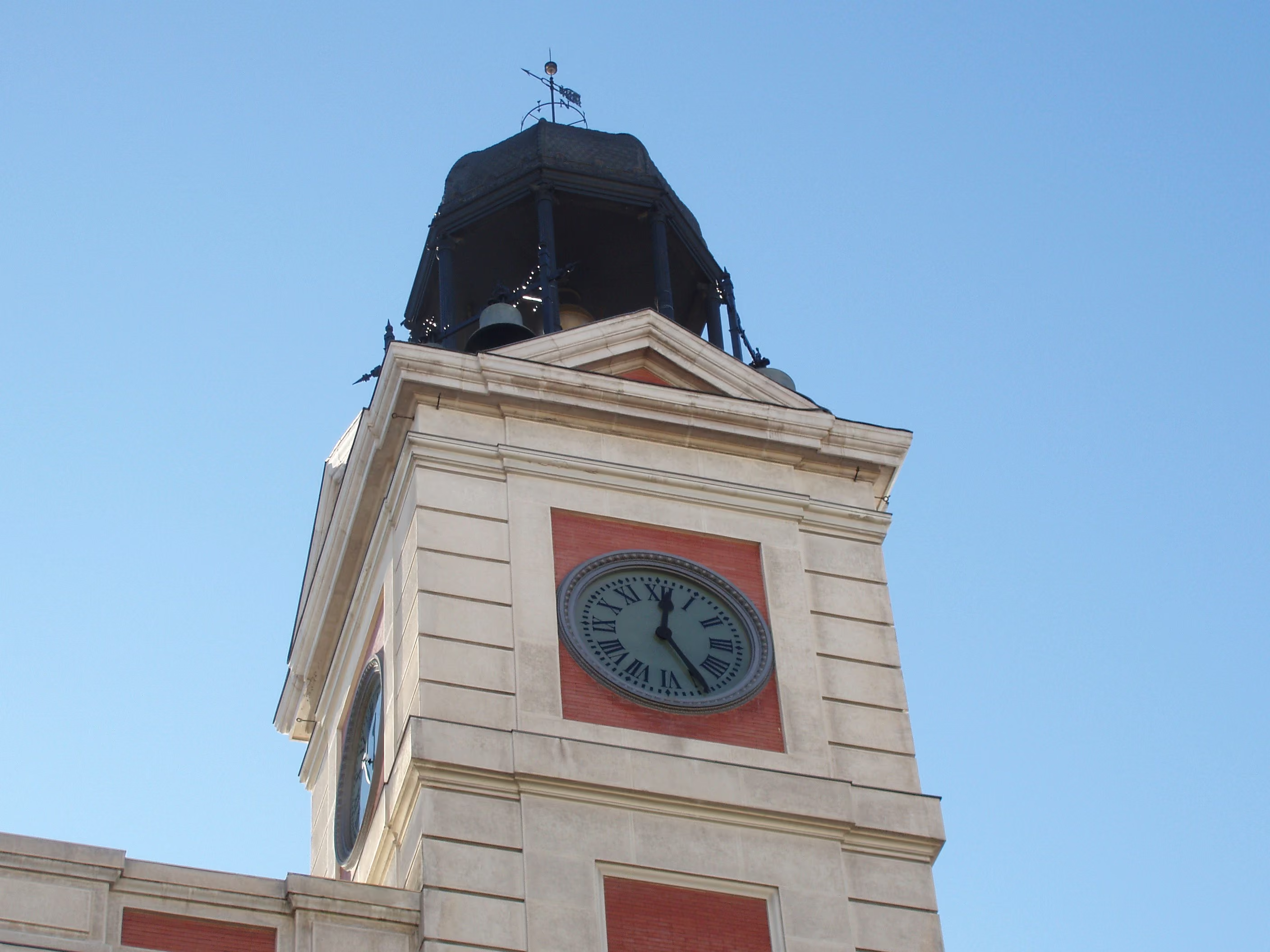
The Puerta del Sol clock keeps time all year round, but its most famous moment lasts barely a few seconds. Every December 31, millions of people watch the ball descend, listen to the four quarter chimes and eat twelve grapes to the rhythm of its strokes.
The mechanism was built by José Rodríguez Losada and inaugurated in 1866. The grape tradition appeared several decades later, and radio and television eventually turned it into a national celebration.
The exiled clockmaker
José Rodríguez Losada was born in 1801 in Iruela, a small village in León. In his youth he supported liberal ideas and, after the restoration of Ferdinand VII’s absolutism, was forced to leave Spain.
He ended up settling in London, where he learned the clockmaker’s trade and opened a shop on Regent Street. His workshop earned great prestige for manufacturing clocks and marine chronometers, instruments essential for ships to calculate their position.
Losada maintained close ties with Spain. He was appointed chronometer maker to the Spanish Navy, and his London establishment became a gathering place for Spanish travelers and exiles.
During a visit to Madrid he learned of the poor performance of the clock installed on the Real Casa de Correos. The mechanism came from the vanished church of the Buen Suceso and suffered constant delays and breakdowns.
Losada decided to build a new one and give it to the city.
The inauguration of 1866
The clock was installed on the tower of the Casa de Correos and inaugurated on November 19, 1866, in the presence of Isabella II. The date did not mark the queen’s birthday, as is sometimes repeated, but the anniversary of her proclamation.
The mechanism controls the hands, the quarters and the hours separately. It runs on weights, gears and a pendulum that regulates the movement. Despite the restorations and improvements made over the years, its basic workings remain as Losada designed them.
The new clock’s precision proved especially important in an era when few people owned one of their own. Shops, stagecoaches, offices and stations needed a reliable public reference.
The time at Sol became the time of Madrid.
The twelve grapes
The custom of eating grapes on New Year’s Eve was not born in 1909, though that date appears frequently.
The Madrid press was already mentioning, in 1896 and 1897, the custom of eating twelve grapes as the clock struck twelve. At first it was associated with well-to-do families imitating the French fashion of celebrating the new year with grapes and champagne. Later, some Madrilenians began going to the Puerta del Sol to eat them in front of the clock.
In 1909, a commercial campaign tied to an abundant harvest helped popularize the so-called lucky grapes. The advertising did not invent the tradition, but it helped it spread throughout Spain.
The clock’s sequence begins before midnight. First the ball above the tower descends. Then the four quarter chimes sound and, after a brief pause, come the twelve strokes. The grapes should be eaten starting with the first stroke, not during the quarters.
From radio to television
Radio made it possible to hear the chimes without being in Madrid. From the 1940s onward, Radio Nacional de España carried the sound of the clock into homes across the country.
Televisión Española made its first broadcast from Sol in 1962. The image of the clock, the descending ball and the crowd gathered in the square has been bound to New Year’s Eve ever since.
The cameras needed to face the Casa de Correos. One of the best vantage points was the balconies of number 11, in the building of the former Fonda de los Príncipes. From there, the dial, the tower and the square could all be seen head-on.
With the arrival of private networks, various balconies of the same building and of neighboring properties became small television studios. Each network chose its own presenters and prepared its own program, but all of them depended on the same clock.
The view from La Fonda
The relationship between the clock and La Fonda began long before television. The hotel opened in 1861, and Losada inaugurated his mechanism five years later. Its first guests could already gaze at the tower from their rooms.
Today, that view can be enjoyed from the balconies of El Mirador de Sol. The clock appears almost head-on, across the square. During the chimes, part of the building once again becomes a broadcast set; the rest of the year, the view allows you to calmly observe a mechanism that normally receives attention for only a few seconds.
Losada built the clock to provide an accurate public time. The grapes, radio and television transformed it into something else: the clock that marks, for millions of people, the beginning of each year.
Frequently asked questions
Who built the Puerta del Sol clock?
What time are the chimes in the Puerta del Sol?
Why are twelve grapes eaten?
Sources
Keep exploring
History of the Puerta del Sol
From medieval gate to the symbolic centre of Madrid: the history of the Puerta del Sol, its great 19th-century renovation, the arrival of transport, its monuments and its role as a gathering place.
LeerThe great renovation that created the Puerta del Sol
The 1857-1862 renovation that created today's Puerta del Sol: the competing designs, the demolitions, Lucio del Valle's arc of buildings and the cost of the new square.
LeerKilometre Zero
The Kilometre Zero plaque, in front of the Real Casa de Correos in the Puerta del Sol, marks the historic origin of Spain's six radial highways. Its history since 1856 and today's compass rose.
LeerWhy It Is Called Puerta del Sol
Puerta del Sol was once a gateway into medieval Madrid, decorated with a sun. Discover how that vanished gate gave the square its name.
Leer