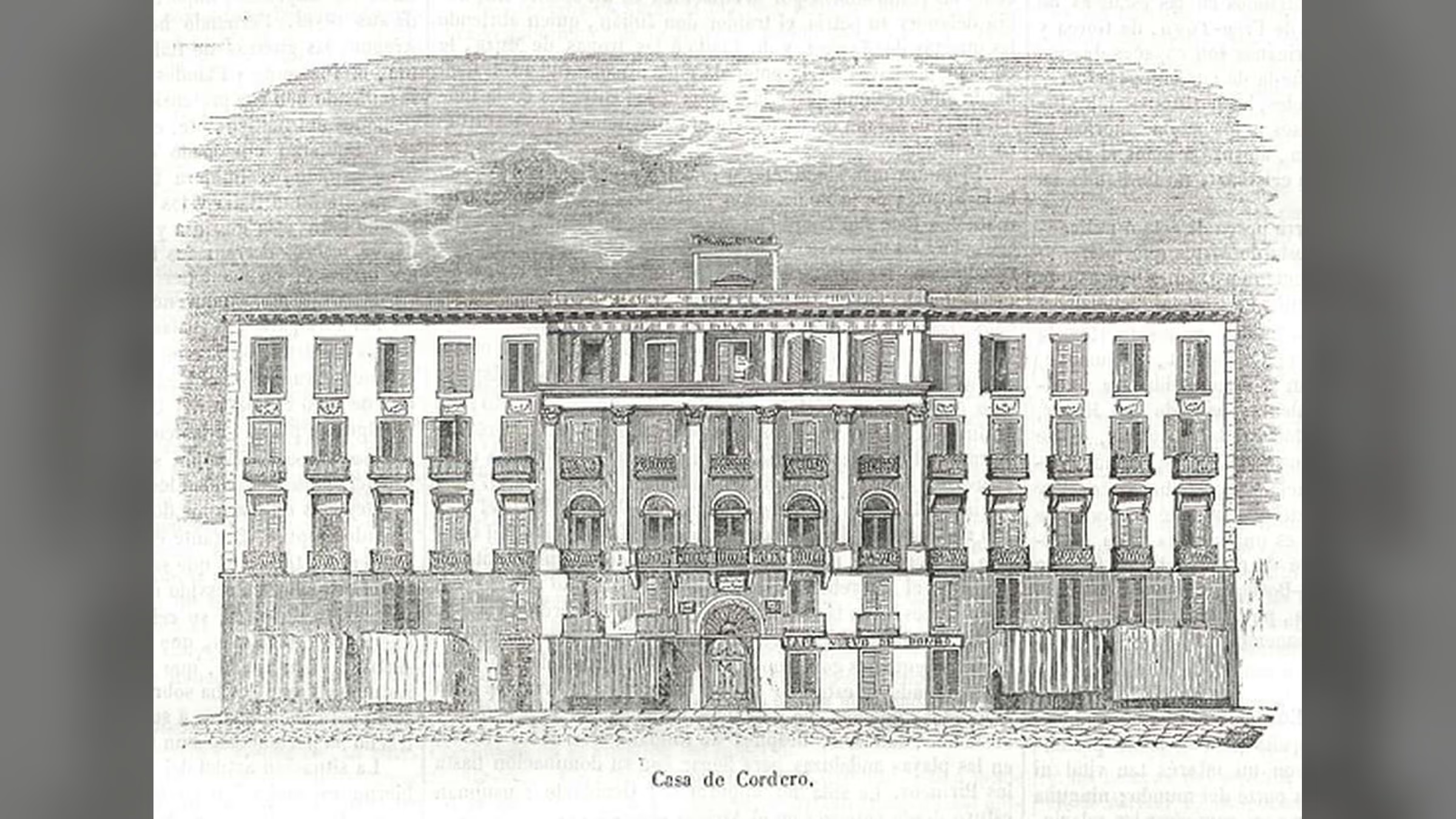
The great building standing between Calle Mayor, Esparteros and the Plaza de Pontejos is known as the Casas de Cordero. It was built between 1842 and 1845, before the great renovation of the Puerta del Sol, and is considered one of Madrid’s first great modern apartment blocks.
Its owner, Santiago Alonso Cordero, was a merchant and politician of Maragato origin. His surname — Cordero means “lamb” in Spanish — was represented by a lamb carved on the corner of Mayor and Esparteros, a visible signature that ended up giving the whole complex its name.
The Casas de Cordero occupy the site of the former convent of San Felipe el Real, celebrated for the steps where Madrileños gathered to exchange news and rumors. The convent’s disappearance made it possible to erect a building of a scale rarely seen in mid-nineteenth-century Madrid.
Santiago Alonso Cordero
Santiago Alonso Cordero was born in 1793 in Santiago Millas, a village in the Maragatería district of León. The Maragato muleteers played an important role in moving goods between Galicia, Castile and Madrid, and Cordero managed to build a considerable fortune through trade and business.
He also took part in the political life of Spanish liberalism. He served as a member of parliament, a senator and president of the Provincial Council of Madrid. In the capital he was known by the nickname el Maragato.
An oft-repeated story holds that he financed the building with a lottery prize. The tale exists in several versions and some of its details are hard to verify, but it became as inseparable from the memory of the Casas de Cordero as the animal carved on its facade. What the reliable documentation does confirm is that Cordero was its first owner and that he promoted one of the most ambitious real-estate projects of the Madrid of his day.
A new building for a new city
The municipal architect Juan José Sánchez Pescador designed a residential complex organized around several interior courtyards. Work began in 1842 and finished in 1845.
The building stood out for its size, the regularity of its facades and the quality of its amenities. In a city still made up of countless narrow, poorly ventilated houses, the Casas de Cordero offered spacious apartments, ground-floor shops and a far more modern layout.
Its construction anticipated the great renovation of the Puerta del Sol by more than a decade. When the demolitions of 1857 began, the building was preserved and became one of the boundaries of the new space. Together with the Real Casa de Correos, it lets us glimpse an era that predates the square we see today.
The Fonda de la Vizcaína
In 1846, the Fonda de la Vizcaína opened on the ground floor, one of the best-known lodgings and restaurants of its time. Its kitchen and its service aspired to European standards, at a moment when the words fonda, casa de huéspedes and hotel were still used with rather loose meanings.
Travelers arrived in Madrid by stagecoach and sought lodging near the transport offices, the post stations and the Puerta del Sol. The building’s location, between Sol and Calle Mayor, was especially convenient.
The Casas de Cordero thus became something more than a residential block. Its floors mixed apartments, inns, restaurants, shops and offices — a blend of uses that anticipated the life of the great buildings later erected around the square.
The Hotel Europa
In time, part of the complex housed the Hotel Europa, whose name still lingers on the facade and in the memory of the building.
The establishment enjoyed a privileged position at the western end of Sol, near Calle Mayor and the Arenal. From its balconies, guests could watch the Casa de Correos, the flow of carriages and, later, the streetcars and the celebrations in the square.
The Hotel Europa belonged to the group of lodgings that made Sol Madrid’s principal hotel district throughout the nineteenth century. Before the Ritz, the Palace and the Gran Vía drew luxury elsewhere, travelers looked for rooms around the square.
The building that replaced the Mentidero
The Casas de Cordero represent one of the most important changes in Sol’s urban history.
Where a convent once rose, a great building of apartments and shops appeared. The steps on which Madrileños traded rumors gave way to hotels, restaurants and shop windows.
The function of the place changed, but it did not vanish entirely. San Felipe had drawn those who wanted to hear the city’s news. The Casas de Cordero went on receiving travelers, residents and merchants at one of the busiest points in Madrid.
Today the building may seem just another piece of the Sol streetscape. Yet when it was built, it was an extraordinary work, both for its size and for its way of understanding urban housing.
It is, moreover, the great survivor of the square that existed before 1857.
Frequently asked questions
Where are the Casas de Cordero?
When were the Casas de Cordero built?
Why are they called Casas de Cordero?
What stood on the site before the Casas de Cordero?
What is the Hotel Europa's connection to the building?
Sources
Keep exploring
History of the Puerta del Sol
From medieval gate to the symbolic centre of Madrid: the history of the Puerta del Sol, its great 19th-century renovation, the arrival of transport, its monuments and its role as a gathering place.
LeerThe great renovation that created the Puerta del Sol
The 1857-1862 renovation that created today's Puerta del Sol: the competing designs, the demolitions, Lucio del Valle's arc of buildings and the cost of the new square.
LeerKilometre Zero
The Kilometre Zero plaque, in front of the Real Casa de Correos in the Puerta del Sol, marks the historic origin of Spain's six radial highways. Its history since 1856 and today's compass rose.
LeerWhy It Is Called Puerta del Sol
Puerta del Sol was once a gateway into medieval Madrid, decorated with a sun. Discover how that vanished gate gave the square its name.
Leer