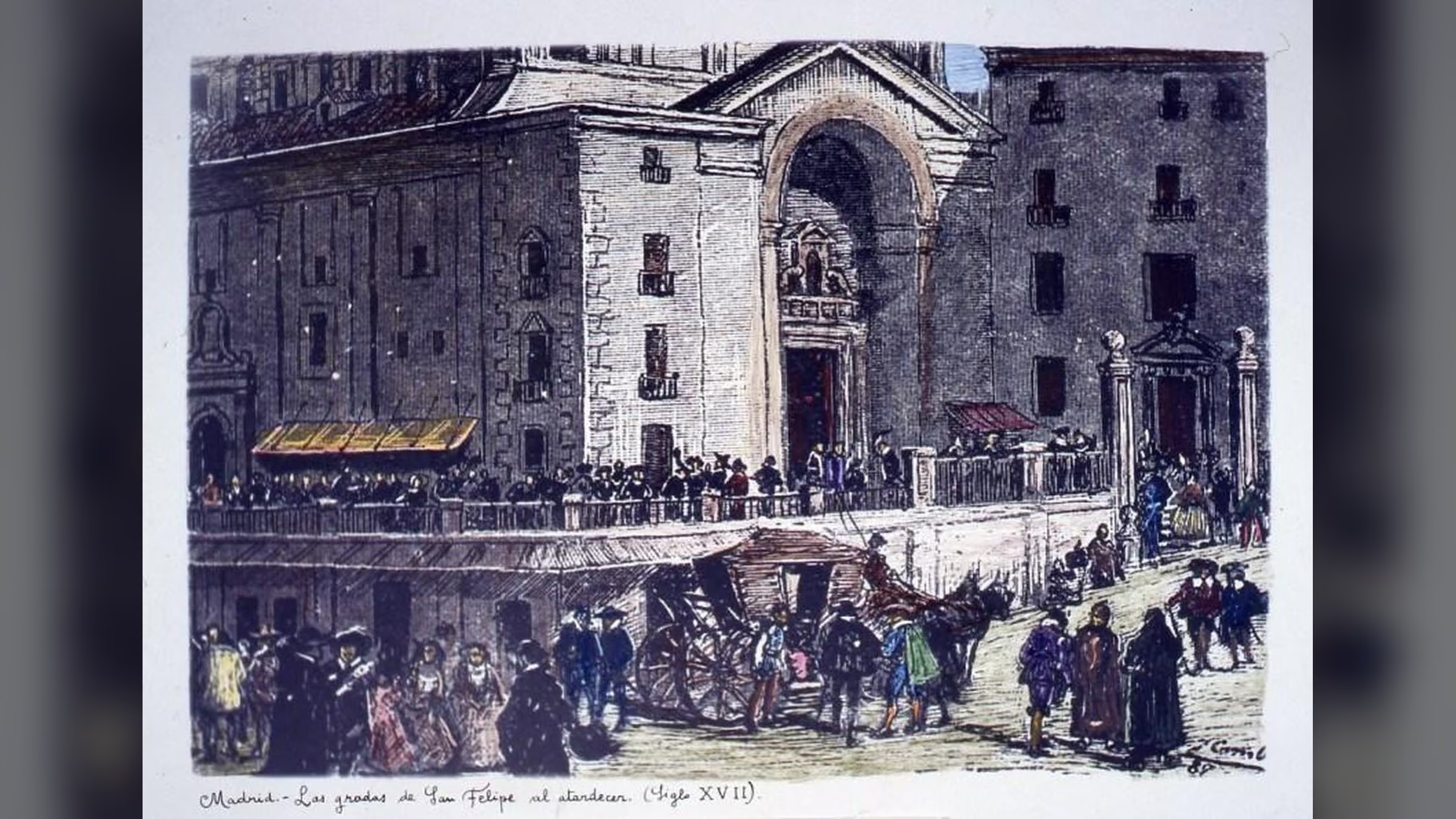
Before the Casas de Cordero, the convent of San Felipe el Real rose at the entrance to Calle Mayor. Its church and its outbuildings occupied one of the most visible spots of the old Puerta del Sol.
The building was important, but its steps mattered even more. There, Madrileños of every station gathered to exchange news, look for work, discuss politics and spread rumors.
The steps of San Felipe became known as the Mentidero de la Villa — the town’s gossip mill.
A convent beside Calle Mayor
San Felipe el Real belonged to the Calced Augustinians and was built between the sixteenth and seventeenth centuries. It stood raised on a great platform protected by railings, at the beginning of Calle Mayor and very close to the Puerta del Sol.
That elevated position gave the building a presence quite unlike anything the Casas de Cordero show today. To reach the church, one had to climb a flight of steps that ended up becoming a public space in its own right.
From up there one could watch the flow of travelers, vendors and carriages crossing the area. The Puerta del Sol was still small and irregular, but it already functioned as one of Madrid’s principal crossroads.
The steps
People came to the steps to converse, but also to find out what was happening. In a city without a daily press accessible to all, without radio and without instant media, information circulated by word of mouth.
Soldiers, servants, civil servants, merchants, office-seekers, travelers and idlers mingled in front of the convent. Some brought news from the court; others knew of an arriving retinue, a vacancy, a war or a political decision.
True information lived alongside exaggeration and falsehood. Hence the word mentidero, from mentir, to lie.
It was not necessarily a place where everything was false. It was a space where every piece of news could be distorted as it passed from one person to the next.
The great hub of rumor
Madrid had several mentideros, but the one at San Felipe was the most famous. Its proximity to the Alcázar, Calle Mayor and the Puerta del Sol made it a natural landing place for political and commercial news.
Writers and men of the theater came too. Rumors about premieres, actors and plays circulated there at speed. The place is bound up with the literary life of the Spanish Golden Age and with the image of a city that talked constantly about itself.
The steps served a role much like the one the cafés of the Puerta del Sol would later play. Anyone who wanted to know what was going on could walk up, listen and join the conversation without belonging to any institution.
The Puerta del Sol inherited that custom. Centuries later, people would still go looking for news in the cafés, in front of the Interior Ministry or among the crowds gathered in the square.
The end of the convent
San Felipe el Real lost part of its functions over the nineteenth century. The desamortización, political upheaval and the growth of the city center reshaped the fate of many Madrid convents, among them the nearby Convento de la Victoria.
The building was demolished and its site became available for a major real-estate venture. Between 1842 and 1845, the Casas de Cordero rose there, designed by Juan José Sánchez Pescador.
The change summed up Madrid’s transformation. A convent of the Old Regime was replaced by apartments, shops, inns and hotels serving a bourgeois and ever more populous city.
No visible trace of the steps remains. The lamb carved on the corner of Mayor and Esparteros now marks an entirely different building.
The legacy of the Mentidero
San Felipe disappeared before the great renovation of the Puerta del Sol. That is why it does not appear in the modern square, and why it is so hard to imagine the space it occupied.
Its function, however, survived.
Sol remained the place Madrileños went to hear the news. In the nineteenth century they did so in the cafés. In 1931 they waited there for the proclamation of the Republic. Then came radio, television and mass demonstrations.
The steps of San Felipe show that this role was not born with the Casa de Correos or the Ministry of the Interior.
Long before, beside Calle Mayor, Madrid had already chosen this place to gather and talk.
Frequently asked questions
Where was San Felipe el Real?
What was the Mentidero de la Villa?
Why was it called a mentidero?
What replaced the convent of San Felipe?
Sources
Keep exploring
History of the Puerta del Sol
From medieval gate to the symbolic centre of Madrid: the history of the Puerta del Sol, its great 19th-century renovation, the arrival of transport, its monuments and its role as a gathering place.
LeerThe great renovation that created the Puerta del Sol
The 1857-1862 renovation that created today's Puerta del Sol: the competing designs, the demolitions, Lucio del Valle's arc of buildings and the cost of the new square.
LeerKilometre Zero
The Kilometre Zero plaque, in front of the Real Casa de Correos in the Puerta del Sol, marks the historic origin of Spain's six radial highways. Its history since 1856 and today's compass rose.
LeerWhy It Is Called Puerta del Sol
Puerta del Sol was once a gateway into medieval Madrid, decorated with a sun. Discover how that vanished gate gave the square its name.
Leer