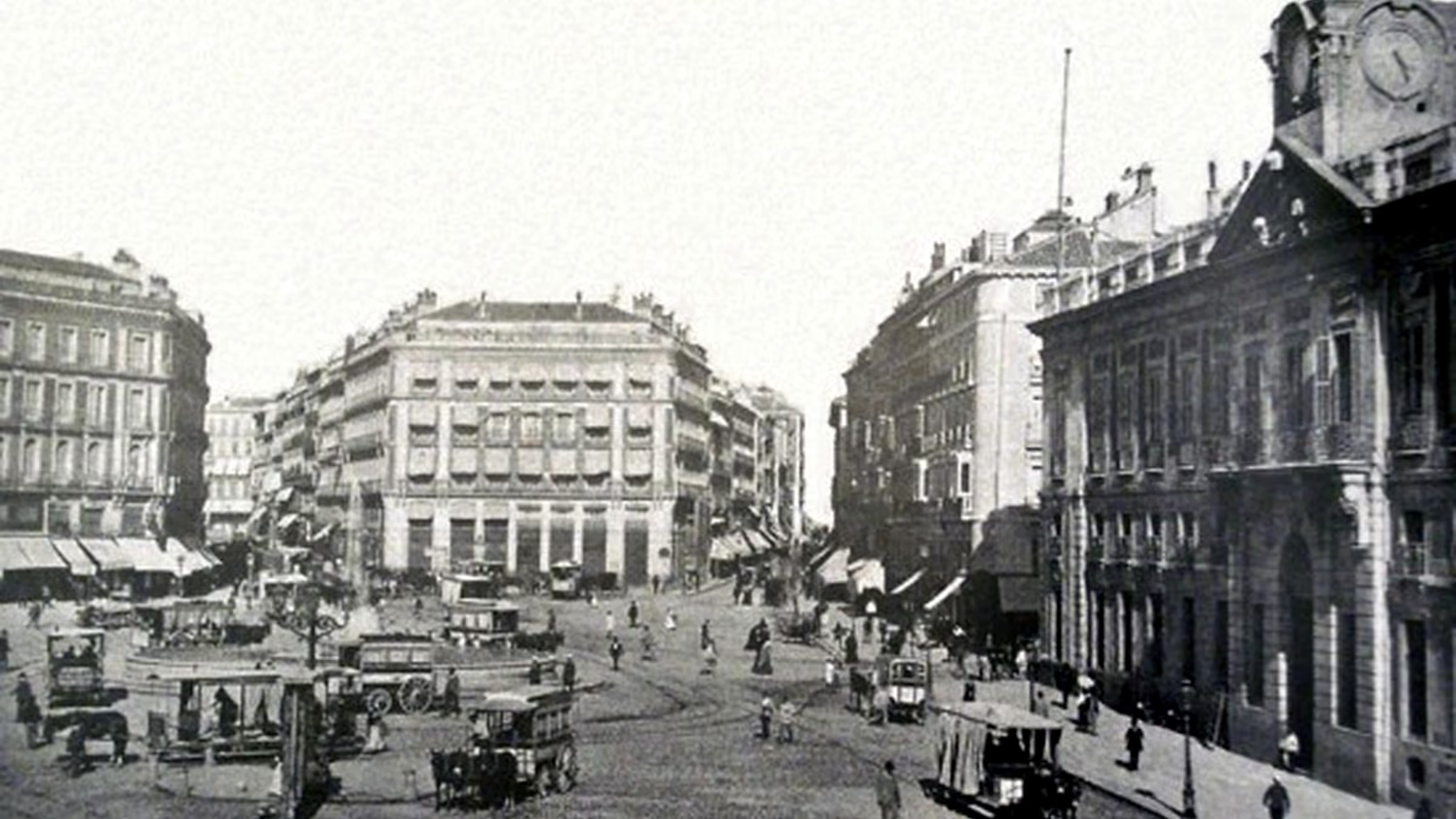
For much of the 19th century, Puerta del Sol was a grand salon filled with cafés. Some occupied small premises, while others spread across entire floors, with mirrors, marble tables, billiard rooms and dozens of waiters.
People did not come merely for a drink. In the cafés they read newspapers, received visitors, wrote articles, argued about politics and closed business deals. Before radio, television and social media, they were among the places where Madrid found out what was happening.
A New Way of Gathering
The cafés made it possible to spend hours in a covered public space. For the price of a single order, a customer could enjoy the light, the heating, the newspapers and a table at which to converse or work.
Puerta del Sol offered an inexhaustible clientele. Travelers, civil servants, merchants, soldiers, journalists and writers all passed through. The Casa de Correos received the mail, the Interior Ministry concentrated political activity, and the hotels lodged those arriving from elsewhere.
The cafés connected all those worlds.
The renovation of the square between 1857 and 1862 created large commercial premises with broad shop windows. Gas lighting made longer hours possible, and some establishments hardly ever closed.
The Café Universal
The Café Universal occupied one of the buildings of the arc and was known as the café of mirrors. The walls reflected the lamps, the tables and the movement of the customers, making the salon appear even larger than it was.
Journalists, politicians and writers gathered at its tables, alongside people who came simply to watch who was coming and going. From its large windows one could observe the traffic of the square without leaving one’s seat.
The tertulias needed no formal organization. A group would habitually occupy the same table, arrive at a set hour, and end up turning that space into a kind of public home.
The Café de la Montaña
The Café de la Montaña occupied the ground floor and part of the mezzanine of the Hotel de París. It had entrances from Sol, Alcalá and the Carrera de San Jerónimo and could host several tertulias at once.
Its most famous episode occurred in July 1899. Ramón María del Valle-Inclán argued with the journalist Manuel Bueno and took a blow from a walking stick to his left arm. The wound became infected and the doctors had to amputate.
The empty sleeve became part of the writer’s public image. It all began with an argument beneath the guest rooms of one of Madrid’s finest hotels.
The Cafés of La Fonda
On the ground floor of the building of La Fonda de los Príncipes operated establishments such as the Café Oriental and the Café de Correos.
The latter took its name from the building across the square and was frequented by civil servants, journalists, students and writers. Its patrons included Azorín and the Madrid chronicler Pedro de Répide.
The relationship between hotel and café came naturally. A guest could come down from his room and find himself in the middle of a tertulia; a Madrileño could walk in off the street and share the salon with travelers newly arrived from other countries.
While the upper floors lodged visitors, the ground floor kept the building awake well into the night.
The End of the Great Cafés
At the start of the 20th century, urban life began to change. The Gran Vía created a new axis of hotels, theaters and shops. Radio brought the news into people’s homes, and the telephone reduced the need to always meet in the same place.
The new bars operated faster and occupied smaller premises. Instead of lingering for hours around a table, customers drank their coffee standing up and went on their way.
The Civil War and the postwar years hastened the disappearance of the great establishments. Their enormous salons were difficult to maintain, and many were replaced by banks, shops and offices.
La Mallorquina, opened in 1894, is one of the few historic businesses still in the square, though it belongs more to the tradition of pastry shops and tearooms than to that of the old political tertulias.
The cafés of Sol disappeared, but they left behind an idea that can still be recognized: the square was not just a place to pass through. It was also a place to sit down and watch Madrid.
Frequently asked questions
What historic cafés were there in Puerta del Sol?
Does any 19th-century café survive in Puerta del Sol?
Where did Valle-Inclán lose his arm?
Sources
Keep exploring
History of the Puerta del Sol
From medieval gate to the symbolic centre of Madrid: the history of the Puerta del Sol, its great 19th-century renovation, the arrival of transport, its monuments and its role as a gathering place.
LeerThe great renovation that created the Puerta del Sol
The 1857-1862 renovation that created today's Puerta del Sol: the competing designs, the demolitions, Lucio del Valle's arc of buildings and the cost of the new square.
LeerKilometre Zero
The Kilometre Zero plaque, in front of the Real Casa de Correos in the Puerta del Sol, marks the historic origin of Spain's six radial highways. Its history since 1856 and today's compass rose.
LeerWhy It Is Called Puerta del Sol
Puerta del Sol was once a gateway into medieval Madrid, decorated with a sun. Discover how that vanished gate gave the square its name.
Leer