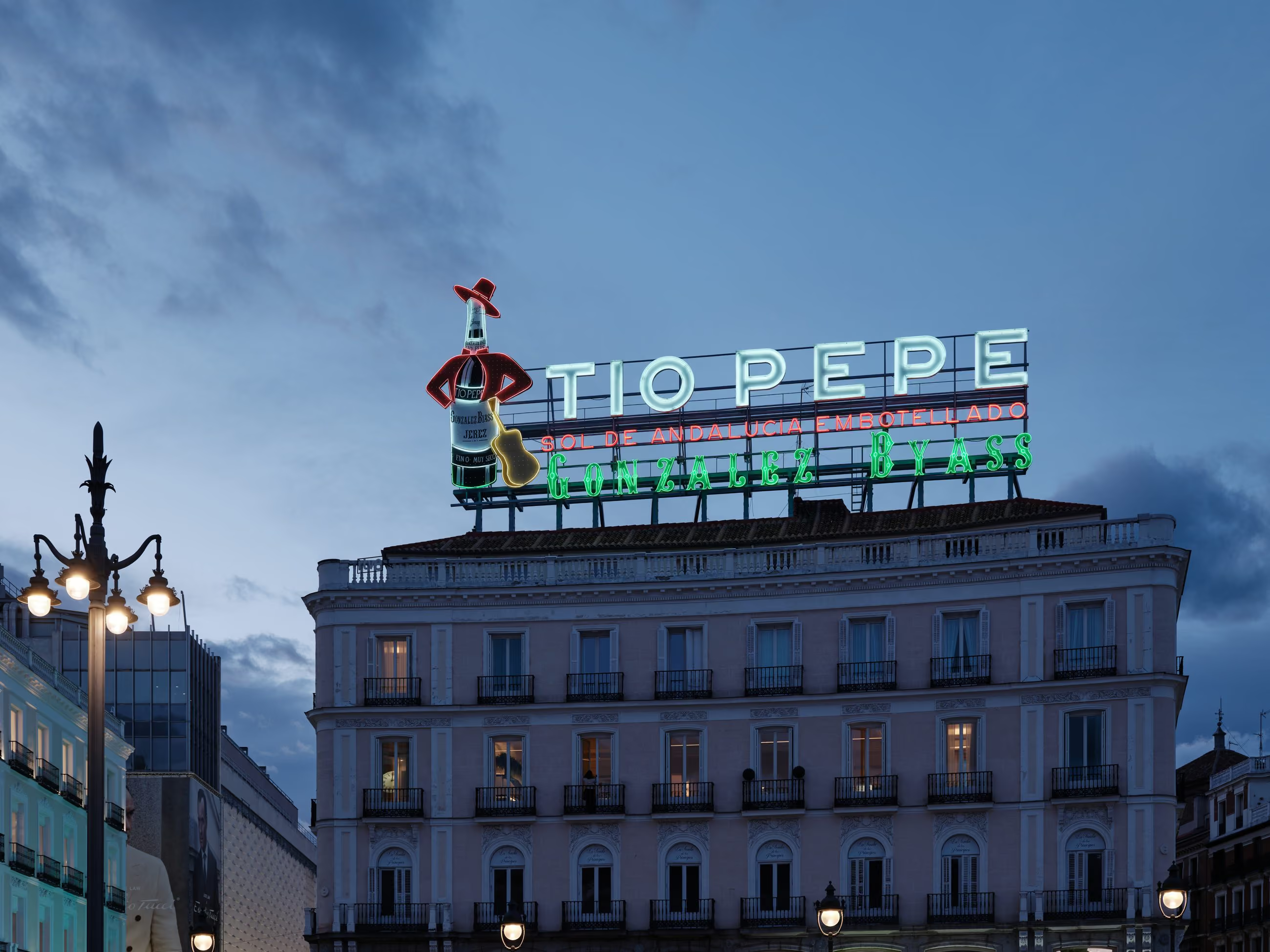
The building between Calle de Alcalá and the Carrera de San Jerónimo currently houses the Apple Store. For 142 years it was the Hotel de París, one of the great establishments born with the new Puerta del Sol.
Travelers and artists stayed in its rooms; some of Madrid’s best-known cafés operated on its ground floor, and for decades the Tío Pepe sign stood on its rooftop.
The hotel closed in 2006 and Apple opened in 2014. The sign never returned to the building: it crossed the square and was installed atop La Fonda de los Príncipes.
A Hotel Above the Buen Suceso
The site had been occupied by the church and hospital of the Buen Suceso, demolished in 1854. The complex’s disappearance made it possible to widen the entrances to Alcalá and the Carrera de San Jerónimo and to free up one of the most valuable plots in the new square.
The building was erected during the great renovation of Sol, and the hotel opened in 1864, initially under the name Fonda de París. The name evoked the city that at the time embodied modernity, luxury and cosmopolitan European life.
La Fonda de los Príncipes had opened three years earlier in the northern arc. Together with the Hotel del Universo and other establishments, the two turned Sol into Madrid’s premier hotel district.
The Hotel de París offered rooms with views, a dining room, salons, baths and services aimed at an international clientele. During its first decades it was considered one of the most prestigious and expensive lodgings in the city.
Travelers, Artists and Cafés
The French painter Édouard Manet stayed at the hotel during his trip to Madrid in 1865. He had come to see for himself the works of Velázquez and Goya held at the Museo del Prado.
The ground floor was as important as the guest rooms. It first housed the Café Imperial and later the Café de la Montaña, one of Madrid’s great tertulia cafés. The establishment had entrances from Sol, Alcalá and the Carrera de San Jerónimo.
In July 1899, Ramón María del Valle-Inclán got into an argument there with the journalist Manuel Bueno. A blow from a walking stick left a wound on his left arm that became infected and had to be amputated a few days later.
For years, the hotel’s rooms and its ground-floor salons brought together two ways of experiencing Madrid: those who arrived from other cities, and those who came daily to converse, read or argue.
Losing the Limelight
At the beginning of the 20th century, Madrid’s hotel center began to shift. The opening of the Ritz in 1910 and the Palace in 1912, together with the construction of the Gran Vía, introduced larger, more modern hotels.
The Hotel de París carried on thanks to its location and its views over Sol, but it gradually lost the standing it had enjoyed in the 19th century. Successive renovations altered rooms, staircases, installations and commercial premises.
While the hotel aged, its rooftop took on a new starring role. In 1935, the advertising man Luis Pérez Solero created the Tío Pepe character for González Byass: a bottle dressed in a short jacket, hat and guitar. The great illuminated sign later installed above the hotel went on to become one of the symbols of the square.
The building ceased to be known by the hotel’s name and came to be identified by the advertisement that crowned it.
The Closure and Apple
The Hotel de París closed on 31 May 2006. It had been 142 years since it opened.
The subsequent restoration was required to preserve the façades and various protected elements, but the hotel use gave way to a large retail establishment. During the works, remains of the old hospital of the Buen Suceso were uncovered in the basement.
The Tío Pepe sign was taken down in 2011. Although many people hoped it would return to the same rooftop, Apple’s new project did not include its reinstallation.
The store opened on 21 June 2014. From the outside, the building retains its rows of balconies and its historic composition. Inside, the old guest rooms gave way to large commercial spaces.
The Sign Crosses the Square
Tío Pepe’s new home was number 11 Puerta del Sol, atop the building of the old Fonda de los Príncipes. The restored sign was lit again on 8 May 2014.
The symbol that for decades had identified the Hotel de París ended up crowning another of the great hotels born during the 19th-century renovation.
Today, many people walk into Apple without knowing they are inside a former hotel. Beneath their feet lie remains of the Buen Suceso and, from its balconies, 19th-century guests once gazed out over the same square that still opens up before the building.
Frequently asked questions
What was the Apple building in Puerta del Sol?
Where was the Tío Pepe sign originally?
What stood there before the Hotel de París?
When did the Hotel de París close?
Sources
Keep exploring
History of the Puerta del Sol
From medieval gate to the symbolic centre of Madrid: the history of the Puerta del Sol, its great 19th-century renovation, the arrival of transport, its monuments and its role as a gathering place.
LeerThe great renovation that created the Puerta del Sol
The 1857-1862 renovation that created today's Puerta del Sol: the competing designs, the demolitions, Lucio del Valle's arc of buildings and the cost of the new square.
LeerKilometre Zero
The Kilometre Zero plaque, in front of the Real Casa de Correos in the Puerta del Sol, marks the historic origin of Spain's six radial highways. Its history since 1856 and today's compass rose.
LeerWhy It Is Called Puerta del Sol
Puerta del Sol was once a gateway into medieval Madrid, decorated with a sun. Discover how that vanished gate gave the square its name.
Leer