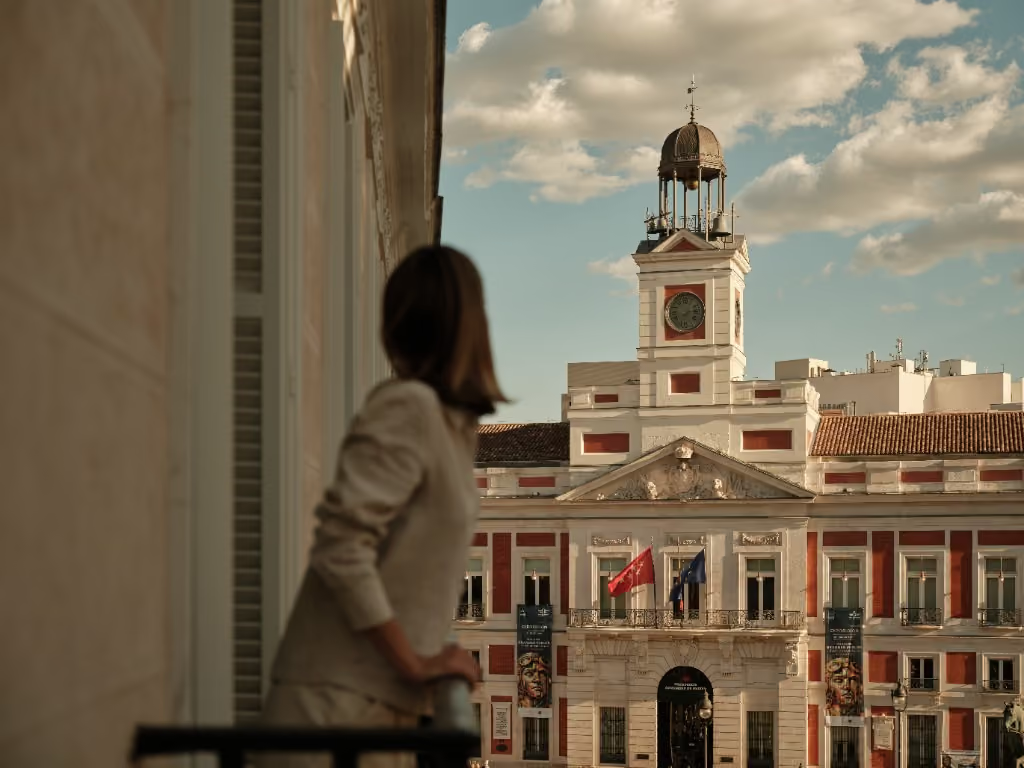
La Fonda de los Príncipes opened on 1 October 1861, before work on the new Puerta del Sol had even finished. The Losada clock did not yet exist, and many of the square’s buildings had only just been built.
The establishment was born within the great arc erected opposite the Casa de Correos and was conceived to welcome travelers arriving in a Madrid increasingly well connected by rail.
Over more than a century and a half it changed names, owners and category. It was the Hotel de los Príncipes, the Gran Hotel de la Paix, the Hotel Americano, the Pensión Americana and the Hostal Americano. It closed in March 2020 and recovered its original name when it reopened on 5 January 2026.
A Hotel Built for Sol
The building occupies a privileged position between the streets of Preciados and Carmen, with additional façades facing Tetuán and the rear of the property. This layout allowed the rooms to be lit and ventilated and provided numerous balconies overlooking the square and the streets.
La Fonda was not installed in an old house adapted for the purpose. It was born inside a new building, constructed during the great renovation of 1857 to 1862.
At the time, the word fonda did not necessarily denote a modest lodging. First-class establishments offered private rooms, salons, a dining room, baths, carriage service and attention for foreign travelers.
The location was one of its main attractions. From Sol it was easy to reach the Royal Palace, the Prado, the theaters, the shops and the government offices. The hotel’s carriages collected guests at the railway stations and carried their trunks right to the door.
From Los Príncipes to La Paix
Shortly after opening, the name Hotel de los Príncipes also came into use. The word hotel, of French origin, was associated with the most modern establishments in Europe.
Around 1875 it was renamed the Gran Hotel de la Paix. An 1876 advertisement boasted of its four façades, its 120 street-facing balconies, its family rooms, private parlours, table d’hôte, interpreters, baths, and the carriages and omnibuses at guests’ disposal.
The establishment aspired to compete with the great hotels of Paris and London. Guests could read European newspapers, receive visitors, hire a carriage or stay for weeks accompanied by their families and servants.
The balconies offered views of the bustle of Sol, the celebrations and the political events unfolding in front of the Interior Ministry. The hotel was not merely located beside the square. It was part of it.
The Hotel Americano
At the beginning of the 20th century, Paris ceased to be the sole benchmark of modernity. The United States now represented electricity, elevators, tall buildings and a new way of urban life.
The Hotel de la Paix was renamed the Hotel Americano. At the same time, Madrid was beginning to open larger, more luxurious establishments. The Ritz, the Palace and the hotels of the Gran Vía gradually pulled the city’s hotel center away from Sol.
The First World War and economic hardship deepened the shift. For a period the establishment operated as the Pensión Americana, with more affordable prices and a clientele that might stay for long stretches.
Jorge Luis Borges lodged there with his family during his years in Madrid. The young writer was part of the Ultraist movement and was beginning to publish some of his earliest texts.
The name Hotel Americano was later revived, but the establishment never regained the position of luxury it had held during the 19th century.
War, Postwar and the Hostal Americano
Puerta del Sol suffered bombing and artillery fire during the Civil War. The building was damaged, particularly on the Calle Tetuán façade.
After the war, its floors and premises were gradually fragmented among hotels, boarding houses, offices, apartments and shops. The unity of the old grand hotel progressively disappeared.
New classification rules forced the establishment to become the Hostal Americano. It offered simple rooms to travelers who valued, above all, the location and a more affordable price.
The hostal carried on while other historic lodgings vanished. The Hotel de París closed in 2006, but at number 11 it was still possible to sleep inside the building that had welcomed its first guests in 1861.
The Chimes and Tío Pepe
The balconies facing the Casa de Correos were used for decades by television networks to broadcast the New Year’s Eve chimes. The cameras could capture a head-on view of the clock, the façade and the crowd gathered in the square.
Millions of viewers watched Sol from the building of the old Fonda without knowing exactly where the set was located.
In 2014 another of the square’s symbols arrived. The Tío Pepe sign, removed from the old Hotel de París during the Apple works, was installed on the rooftop of number 11.
The illuminated sign that had crowned one of the great 19th-century hotels for decades came to rest atop another.
Closure and Recovery
The Hostal Americano closed in March 2020. The pandemic brought travel to a halt and left Puerta del Sol empty.
In 2024, a project began to restore the building’s hotel activity and return the establishment to its first name. The restoration renewed rooms, bathrooms, installations, climate control, soundproofing and common areas.
The intention was not to literally reconstruct a 19th-century fonda. The hotel had to meet today’s needs while preserving the historic relationship between the building, its travelers and the square.
La Fonda de los Príncipes reopened on 5 January 2026, almost 165 years after its inauguration.
El Mirador de Sol
El Mirador de Sol recovers a part of the life that has always existed within the building. Its five balconies open toward the Casa de Correos and offer a head-on view of the Losada clock.
By day, you can watch the movement of the square; by night, the illuminated façades and the Tío Pepe sign form part of the landscape. On New Year’s Eve, the balconies once again become part of the television broadcasts.
Today’s travelers arrive by plane, Metro or Cercanías and book from their phones. They are very different from those who arrived by stagecoach with trunks and servants.
The building continues to fulfill the very purpose for which it was built: to lodge them facing Puerta del Sol.
Frequently asked questions
Where is La Fonda de los Príncipes?
When did La Fonda de los Príncipes open?
What names has it had throughout its history?
Can you see the New Year's Eve chimes from La Fonda?
Sources
Keep exploring
History of the Puerta del Sol
From medieval gate to the symbolic centre of Madrid: the history of the Puerta del Sol, its great 19th-century renovation, the arrival of transport, its monuments and its role as a gathering place.
LeerThe great renovation that created the Puerta del Sol
The 1857-1862 renovation that created today's Puerta del Sol: the competing designs, the demolitions, Lucio del Valle's arc of buildings and the cost of the new square.
LeerKilometre Zero
The Kilometre Zero plaque, in front of the Real Casa de Correos in the Puerta del Sol, marks the historic origin of Spain's six radial highways. Its history since 1856 and today's compass rose.
LeerWhy It Is Called Puerta del Sol
Puerta del Sol was once a gateway into medieval Madrid, decorated with a sun. Discover how that vanished gate gave the square its name.
Leer