Sol station began as one end of a line barely four kilometers long. Today it connects three Metro lines with the Cercanías commuter rail and provides a direct route to the center of Madrid from much of the city and the surrounding region.
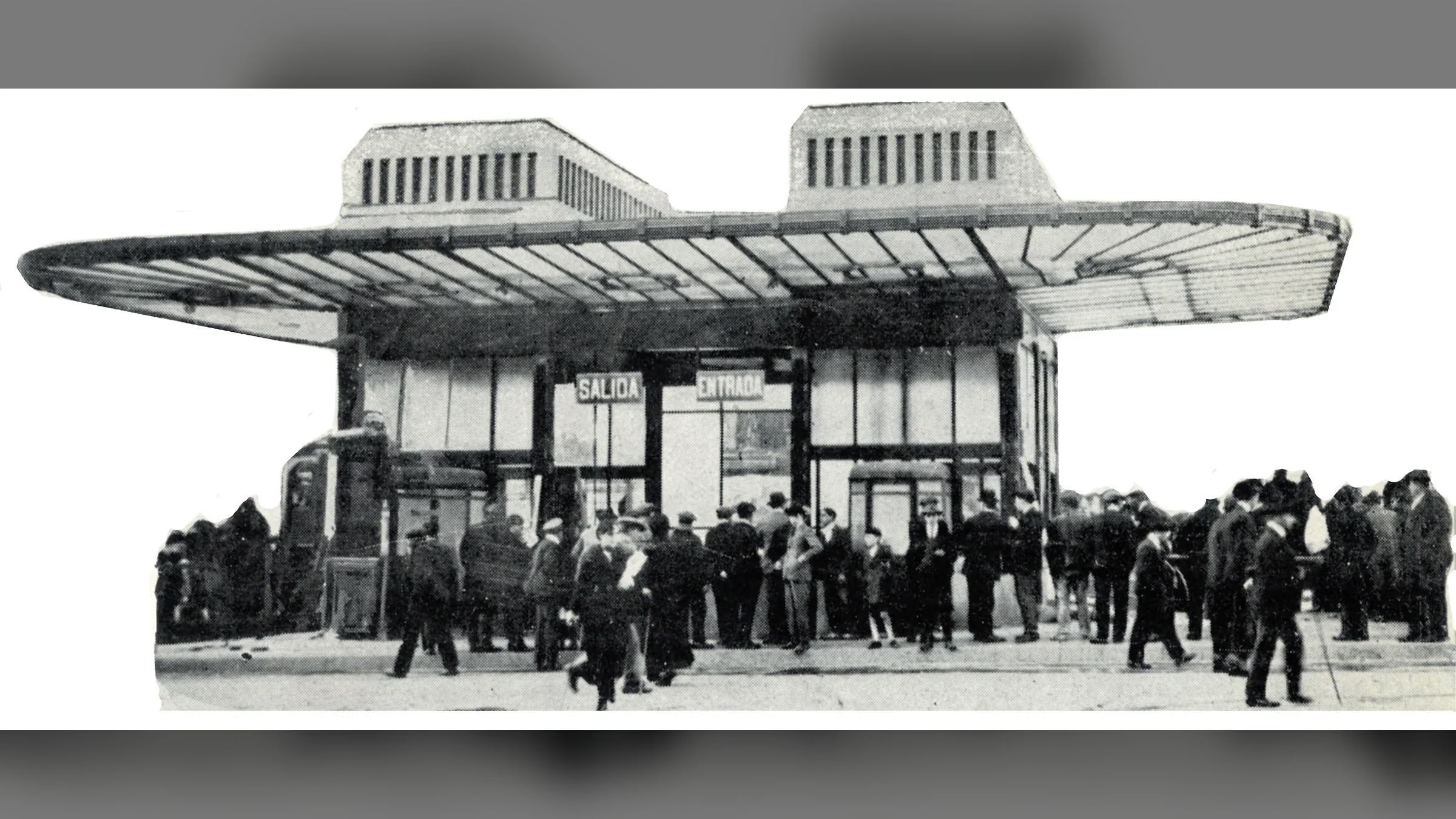
Its story began in 1919, when traveling underground was still an entirely new experience. The entrance to the station was marked by a pavilion designed by Antonio Palacios, the architect who gave Madrid’s first Metro much of its visual identity.
Madrid’s first Metro
The line between Sol and Cuatro Caminos was inaugurated by Alfonso XIII on October 17, 1919, and opened to the public a few days later.
It had eight stations and ran roughly four kilometers. Sol was the starting point of the new system, connecting the center with the neighborhoods growing to the north of Madrid.
The journey was far faster than crossing the city amid streetcars, carriages and automobiles. The station lay some thirteen meters underground, and its platforms, corridors and cladding were designed to convey cleanliness, safety and modernity.
Antonio Palacios shaped the architectural image of the whole system. He designed entrances, railings, tiles and graphic elements that made the stations instantly recognizable.
The Sol pavilion
The Sol entrance had to handle the descent of a great number of passengers. To give it greater visibility and monumentality, a pavilion was built at street level.
The structure stood in the center of the square and combined stone, iron, glass and ceramics. It was no ordinary Metro entrance. It announced that beneath Sol lay an infrastructure capable of competing with those of London, Paris or New York.
The interior was clad in light-colored marble and decorated with ceramics and regional coats of arms. Staircases led down to the station’s ticket hall.
The pavilion was part of Sol’s image for fifteen years. It was dismantled in 1934, when Metro expansions and changes in the layout of the square made it necessary to reconfigure the entrances.
It should not be confused with the famous elevator pavilion of Gran Vía, also designed by Palacios, whose original is preserved in O Porriño. The Sol pavilion is gone.
Three lines beneath the square
The network grew quickly. Line 2 connected Sol with Ventas, and line 3 added a new axis toward the south and north of Madrid.
Each expansion required building tunnels, corridors and concourses in an increasingly crowded subsoil. The stations do not form a single hall but rather distinct levels linked by passageways and staircases.
For decades, the surface remained filled with streetcars, buses, taxis and automobiles. Sol functioned simultaneously as a street-level crossroads and an underground interchange.
When the square became pedestrian, the transport disappeared from view — but it never stopped passing through.
The arrival of Cercanías
In 2004, work began on a Cercanías commuter rail station inside the new railway tunnel between Atocha and Chamartín.
The project was exceptionally difficult. Beneath the square there were already three Metro lines, utility conduits, foundations and archaeological remains.
During the excavations, walls belonging to the old church and hospital of the Buen Suceso came to light. A section was preserved inside the concourse and can be seen today protected behind glass.
The Cercanías station opened in 2009. It allows passengers to arrive from Atocha in about three minutes and from Chamartín in roughly seven.
The whale and today’s pavilions
The new station needed spacious entrances, elevators and ventilation systems. To bring them together, a great curved glass structure was built, quickly nicknamed the whale.
The pavilion became one of the most visible and most debated features of the square. It let in light and eased passenger flow, but it hid part of the facades and occupied a very large central space.
The redevelopment begun in 2022 removed the whale and replaced it with two lower pavilions, designed to reduce their visual presence and organize the entrances.
The station keeps growing beneath an increasingly uncluttered surface.
Today Sol looks like a traffic-free pedestrian square. Every few minutes, however, Metro and Cercanías trains pass beneath its monuments.
Frequently asked questions
When did the Sol Metro station open?
What was Antonio Palacios's pavilion in Sol?
How many lines pass through Sol station?
When did Cercanías Sol open?
What happened to the whale of Sol?
Sources
Keep exploring
History of the Puerta del Sol
From medieval gate to the symbolic centre of Madrid: the history of the Puerta del Sol, its great 19th-century renovation, the arrival of transport, its monuments and its role as a gathering place.
LeerThe great renovation that created the Puerta del Sol
The 1857-1862 renovation that created today's Puerta del Sol: the competing designs, the demolitions, Lucio del Valle's arc of buildings and the cost of the new square.
LeerKilometre Zero
The Kilometre Zero plaque, in front of the Real Casa de Correos in the Puerta del Sol, marks the historic origin of Spain's six radial highways. Its history since 1856 and today's compass rose.
LeerWhy It Is Called Puerta del Sol
Puerta del Sol was once a gateway into medieval Madrid, decorated with a sun. Discover how that vanished gate gave the square its name.
Leer