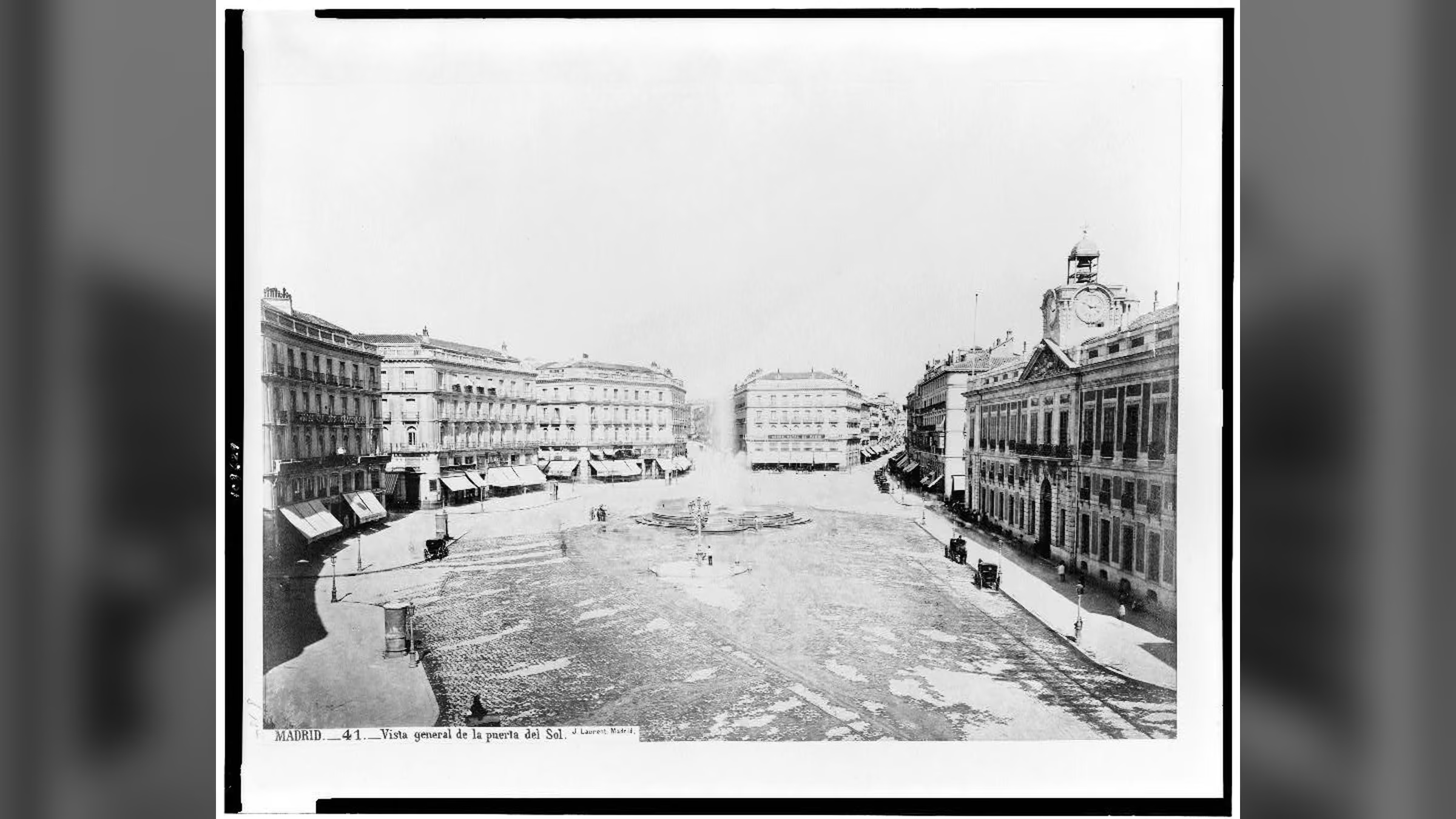
At the end of the Puerta del Sol closest to Calle de Alcalá stood the Hotel del Universo. Its lower floors housed the Café Universal, one of the great Madrid cafés of the nineteenth century.
The establishment was known as the café of mirrors for the abundance of glass panels that covered its salons. Among its patrons was a young Benito Pérez Galdós, newly arrived from the Canary Islands and still far from becoming one of Spain’s great novelists.
A hotel on the new square
The Hotel del Universo was one of the lodgings that sprang up around the Puerta del Sol after the renovation of 1857 to 1862. Various sources place its opening around 1870, which would make it one of the last great hotels added to the new square.
It stood at the old number 15, later number 14, near the beginning of Calle de Alcalá. From its rooms, guests could look out over the Casa de Correos, the passing streetcars and much of the square.
The hotel belonged to a cluster of establishments that included the Hotel de París, the Fonda de los Príncipes, the Hotel Europa and other, smaller lodgings.
Sol had become the most convenient place to stay for anyone arriving in Madrid: it was close to the theaters, the shops, the ministries and the offices from which transport services departed.
The Café Universal
The ground floor housed the Café Universal, one of the most elegant and popular establishments on the square.
Its decor combined white and gold, divans, chairs, marble tables and countless mirrors that multiplied the light and movement of the salon. Hence its popular name: the café of mirrors.
Customers could spend hours reading newspapers, writing letters, conversing or watching people come in. The café offered a covered public space in a city where private homes did not always allow visitors to be received in comfort.
Like the other great cafés of Sol, it was at once a drawing room, an informal office and an observatory of Madrid life.
Galdós and the Canarian tertulia
Benito Pérez Galdós arrived in Madrid in 1862 to study law.
Shortly afterward he began frequenting the Café Universal, home to a tertulia of students and residents from the Canary Islands. Among them were the León y Castillo brothers and other figures who would later go on to important political and intellectual careers.
For the young Galdós, the café offered something the university could not: direct contact with how Madrileños spoke, argued and carried themselves.
From its tables he could observe civil servants, bourgeois patrons, journalists, merchants and travelers. That social mix would eventually find its way into his novels.
The Puerta del Sol was one of the great stages of his education as a writer.
A square reflected in mirrors
The Café Universal made it possible to watch Sol from indoors. The mirrors did not merely enlarge the salon; they reflected the square, the customers and the lighting.
In an age without audiovisual displays, the public itself was the spectacle. Anyone seated in the café could watch and be watched.
The tertulias had their regular tables and regular hours. Groups formed around political, regional or literary affinities. Some conversations lasted for years and accompanied the evolution of their participants.
The establishment continued operating through much of the twentieth century, although changes of ownership and renovations altered its appearance.
The end
The great cafés began losing ground with the arrival of new consumer habits, radio, the telephone and fast-service bars.
The Gran Vía drew part of the city’s nightlife and commerce away from Sol. The great salons were expensive and hard to maintain.
The Café Universal was one of the last great historic cafés on the square. It closed for good in January 1974, after more than a century bound up with the life of Sol.
The hotel disappeared as well, and its spaces were taken over by other businesses.
Today no grand sign remains to identify it. Its memory survives mainly in photographs, in commercial records and in the Madrid chapters of Galdós’s biography.
The café of mirrors is gone, but for decades it offered one of the finest ways to observe the Puerta del Sol: seated at a table, watching the whole square reflected inside.
Frequently asked questions
Where was the Hotel del Universo?
Why was the Café Universal called the café of mirrors?
What was Benito Pérez Galdós's connection to the Café Universal?
When did the Café Universal close?
Sources
Keep exploring
History of the Puerta del Sol
From medieval gate to the symbolic centre of Madrid: the history of the Puerta del Sol, its great 19th-century renovation, the arrival of transport, its monuments and its role as a gathering place.
LeerThe great renovation that created the Puerta del Sol
The 1857-1862 renovation that created today's Puerta del Sol: the competing designs, the demolitions, Lucio del Valle's arc of buildings and the cost of the new square.
LeerKilometre Zero
The Kilometre Zero plaque, in front of the Real Casa de Correos in the Puerta del Sol, marks the historic origin of Spain's six radial highways. Its history since 1856 and today's compass rose.
LeerWhy It Is Called Puerta del Sol
Puerta del Sol was once a gateway into medieval Madrid, decorated with a sun. Discover how that vanished gate gave the square its name.
Leer