The current fountain of the Puerta del Sol, presided over by the equestrian statue of Charles III, is the latest in a long line. For four centuries, water has appeared and disappeared from the center of the square in strikingly different forms.
Some fountains were built to supply the neighborhood with water. Others celebrated the arrival of water from the Canal de Isabel II or formed part of renovations designed to beautify Sol. Several were dismantled and rebuilt elsewhere in Madrid.
The history of these fountains traces the transformation of the square: from a place people visited with water jugs to a grand, monumental pedestrian space.
The first fountain and the Mariblanca
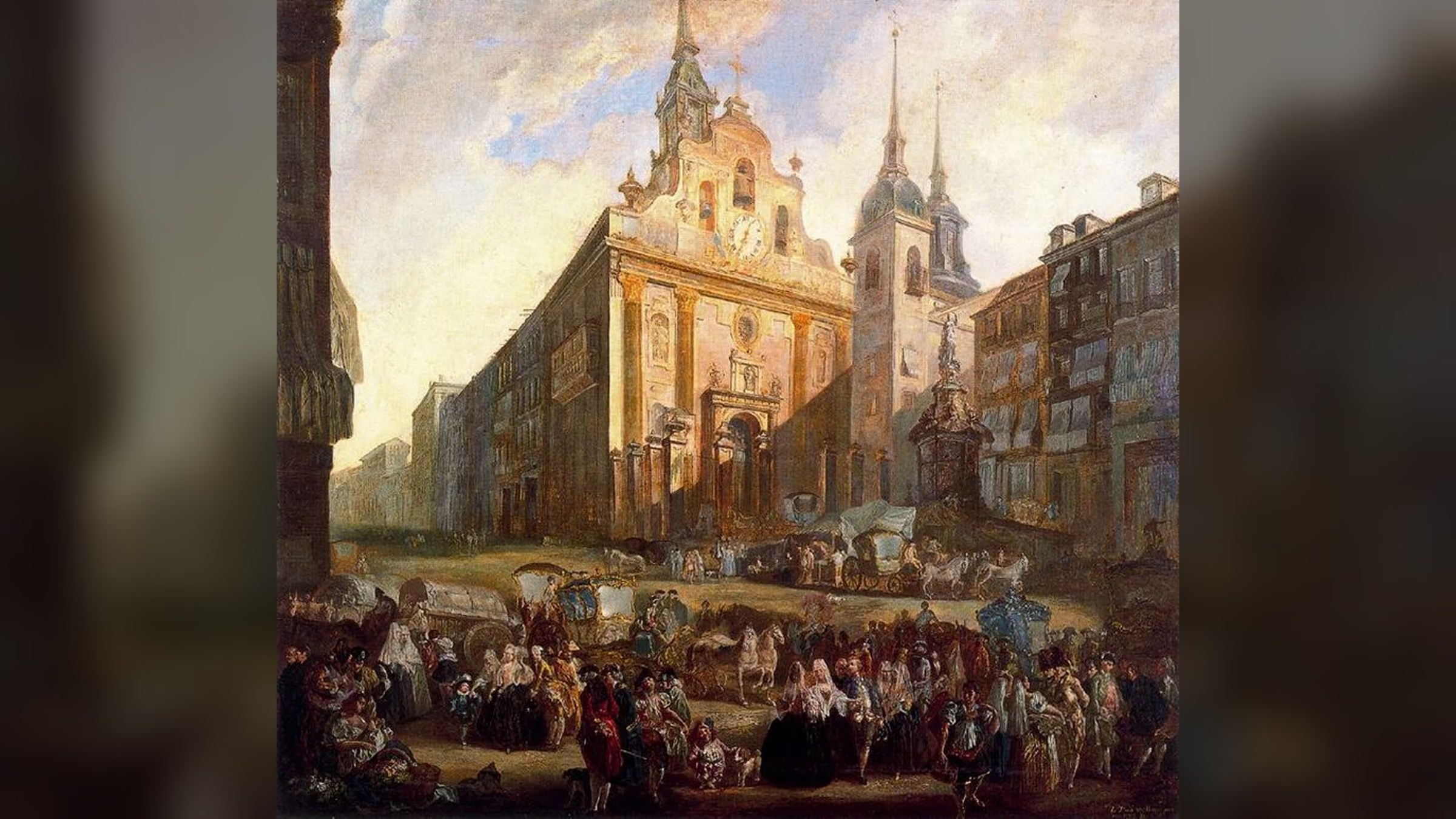
By the early 17th century, a modest fountain already stood in front of the Buen Suceso hospital. In 1616 it was decided to replace it with a far more ambitious ensemble, initially commissioned from Juan Gómez de Mora.
The final work was designed by the Italian sculptor Rutilio Gaci and completed in 1630. It featured a large basin, sculpted masks and four harpy figures from which the water flowed. At the top stood a marble statue purchased in Florence in 1625.
The figure probably represented Venus, but the people of Madrid began calling her the Mariblanca for the color of her stone. The popular name ultimately won out over any mythological identification.
That fountain was not merely ornamental. Water was collected in jugs and carried to homes by residents and water sellers. Animals drank at the basin too, and vendors and travelers gathered around it.
The fountain was remodeled several times until it was dismantled in 1838. The Mariblanca was preserved, and there began a long succession of moves through different corners of Madrid.
A square without a fountain
After the Mariblanca was removed, Sol remained without a great central fountain for some years.
The square still had its old irregular shape and was on the verge of a complete transformation. The Buen Suceso was demolished in 1854 and, three years later, work began on the great renovation that created the present arc of buildings.
The new square needed an element capable of occupying its center, but it was also becoming one of Madrid’s busiest crossroads for carriages and pedestrians. Any monument would have to coexist with increasingly heavy traffic.
The provisional fountain of 1860
On June 24, 1860, a new fountain was inaugurated in the Puerta del Sol. It celebrated the arrival in Madrid of the waters of the Canal de Isabel II, one of the great public works of Queen Isabella II’s reign.
The water shot up with such force, reaching a height that astonished the people of Madrid, who were accustomed to the old underground water channels and a far more limited supply.
Although it was called a provisional fountain, it ended up remaining in the square for years. Its appearance kept changing, and the ensemble underwent various modifications before being dismantled.
Its elements did not disappear entirely. Part of the structure was moved and reused in the Casa de Campo, where it went through several reconstructions and locations.
The Sol fountain thus ended up as a scattered piece of the park’s history.
Water and traffic
By the late 19th and early 20th centuries, the center of Sol was increasingly taken over by transportation. Streetcars crossed the square in several directions, horse-drawn carriages waited for passengers, and the first automobiles were beginning to circulate.
Monumental fountains were difficult to maintain in a space that functioned as a transit hub.
Sol progressively lost the elements that obstructed movement. During certain periods, the center of the square was occupied by small gardens, traffic islands, stops and structures related to transportation.
Water ceased to be a daily necessity and came to be understood purely as urban decoration.
The two fountains of 1951
Between 1950 and 1951, the municipal architect Manuel Herrero Palacios directed a major renovation of the Puerta del Sol.
The project created a landscaped central area and installed two twin fountains of neo-Baroque inspiration. They were two stone basins with jets, placed symmetrically within the new space.
The square then took on an appearance very different from today’s. At its center were gardens, benches and fountains, while traffic circulated around them. The decoration attempted to humanize a place dominated by buses, taxis and automobiles.
The two fountains remained in Sol for more than three decades. In 1985 they were removed and installed on the paseo de Federico García Lorca, in Vallecas, where they remain to this day.
Once again, Madrid had dismantled fountains from Sol to give them a second life somewhere else.
The fountains of the 1986 renovation
The 1986 remodeling eliminated the central gardens and reorganized the square as an elongated space, divided between a pedestrian zone and a wide roadway.
Two new circular fountains of simpler design were installed, occupying the central section for decades. Around them were placed benches, streetlamps and other elements of traditional appearance.
The Mariblanca also returned to Sol in the form of a replica, though she no longer crowned a fountain. She became a free-standing statue, separated from the purpose for which she had come to Madrid in the 17th century.
The two circular fountains survived the Cercanías works and the subsequent modifications of the square. For years they flanked the statue of Charles III, which stood on its pedestal without being integrated into either of them.
The Charles III fountain
The renovation approved in 2022 decided to replace the two circular fountains with a single oval piece set at the center of the square.
The new fountain was to house the statue of Charles III and become the main element around which the pedestrian space would be organized. Its dark gray stone bottom and small points of light were conceived to evoke a starry sky.
The installation was technically complex. Beneath the fountain run Metro lines, Cercanías tunnels, utility conduits and technical spaces. The weight of the statue, the pedestal and the water had to be distributed without damaging the underground infrastructure.
In April 2023, Charles III was moved to his new position and came to preside over the current fountain.
The water always returns
The fountains of Sol have answered very different needs.
The Mariblanca provided water to a city that did not yet have household supply. The fountain of 1860 celebrated a great hydraulic engineering feat. The fountains of 1951 and 1986 tried to order and beautify a square dominated by traffic. The current one belongs to a completely pedestrian space.
Almost none of them stayed forever.
Some were dismantled, others relocated, and a few simply vanished. Their remains can be found today in Vallecas, in the Casa de Campo, or safeguarded inside municipal buildings.
The Puerta del Sol has changed so many times that even its fountains have ended up traveling across Madrid.
The current one seems to occupy the natural center of the square, but history advises against considering it definitive. In Sol, even the water changes places.
Frequently asked questions
How many fountains has the Puerta del Sol had?
What happened to the Mariblanca fountain?
Where are the Sol fountains of 1951?
When was the current Charles III fountain built?
Sources
Keep exploring
History of the Puerta del Sol
From medieval gate to the symbolic centre of Madrid: the history of the Puerta del Sol, its great 19th-century renovation, the arrival of transport, its monuments and its role as a gathering place.
LeerThe great renovation that created the Puerta del Sol
The 1857-1862 renovation that created today's Puerta del Sol: the competing designs, the demolitions, Lucio del Valle's arc of buildings and the cost of the new square.
LeerKilometre Zero
The Kilometre Zero plaque, in front of the Real Casa de Correos in the Puerta del Sol, marks the historic origin of Spain's six radial highways. Its history since 1856 and today's compass rose.
LeerWhy It Is Called Puerta del Sol
Puerta del Sol was once a gateway into medieval Madrid, decorated with a sun. Discover how that vanished gate gave the square its name.
Leer